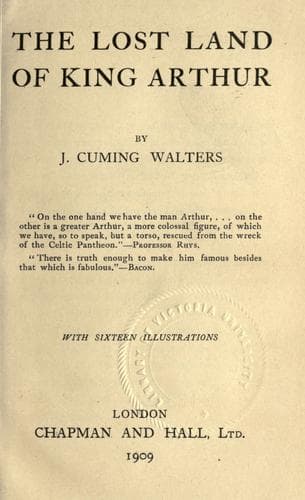
Arthur, King -- Homes and haunts -- England -- Cornwall (County); Cornwall (England : County) -- Antiquities, Celtic
returning to Camelot, saddened and disgraced, was bidden by the king
and queen henceforth to “be with al ladyes and to fight for their
quarrels.”
It is worthy of note that Gawaine not only plays a most important part
in the romance, but that, like Sir Kay, his character is variously
described and at times unnecessarily assailed by the chroniclers. By
laborious efforts his intentions are perverted and contempt thrown upon
his actions, and the episode of the “foule and shameful” slaying of the
lady enabled the chroniclers to dwell upon his “vilanous” deed and his
mercilessness, while at the same time they were able to explain his
subsequent acts of courtesy as the result of the duty put upon him by
the king. Gawaine was Arthur’s nephew, the son of Morgan le Fay, and
Malory presents him to us alternately as the soul of chivalry and the
type of faithlessness. This accounts for Tennyson’s query, “Art thou
not he whom men call light-of-love?” and for the poet’s assertion that
his courtesy had “a touch of traitor in it.” Gawaine is frequently
made the subject of reproof in the romance, though he came out nobly
in the end when he vowed to be revenged on sinful Lancelot, fought him
valorously, and died like a great hero. According to the original Welsh
story, it must be remembered, Gawaine was called the Golden-Tongued,
owing to his powers of persuasion, none being able to resist him what
he asked. In the Triads he is addressed by Arthur as “Gwalchmai, of
faultless answers,” and revolting Tristram, who dared the king to nine
hundred combats, listened to Gawaine and yielded to his solicitation.
The tomb of Gawaine, according to William of Malmesbury, was discovered
in the time of William the Conqueror in Wales, county Pembroke, where
Lady Charlotte Guest tells us there is a district called Castell
Gwalchmai. Gawaine’s courtesy was proverbial in Chaucer’s time, and
the Welsh historians impute to him great scientific learning--“there
was nothing of which he did not know the elements and the material
essence.” Hence Scott’s reference to “the gentle Gawain’s courteous
lore.”[25] All this is inconsistent with the levity and harshness
attributed to him by Malory, though his wanton betrayal of Sir Pelleas
and his guilty relations with Ettarde exposed him to the charge of
infamy and caused him to lose grace in the sight of those chroniclers
who had begun to give a spiritual significance to the tales of Arthur’s
Court, and to find in the recital opportunities for preaching purity.
Public-domain text, read in full here on John Shaqi.
Reviews
Reviews
No reviews yet
Be the first to share your thoughts on this work.
Elsewhere in the archive
Join the Discussion
Join the discussion
Sign in to leave a comment or review.
Sign InorCreate an account