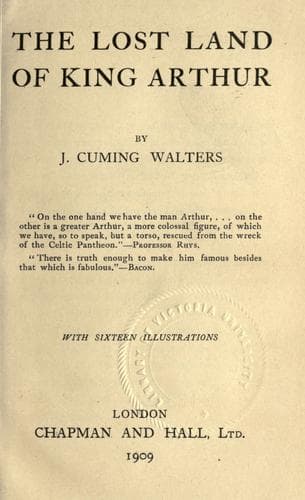
Arthur, King -- Homes and haunts -- England -- Cornwall (County); Cornwall (England : County) -- Antiquities, Celtic
Pelleas’s hopeless love for the scornful maiden is one of the saddest
stories which form part of the Arthurian records. In his despair at
being rejected by the “sovereign lady” for whom he had fought and
prevailed, he sought the help of Sir Gawaine--“And, Sir Knight, sith
ye are so nigh a cousin unto King Arthur, and a king’s son, therefore
I pray thee, betray me not, but help me, for I may never come by her
but by the help of some good knight; for she is in a strong castle
here fast by, within this four miles, and over all this country she
is lady of.” Gawaine vowed to serve him, and declared that he would
ride to the castle, taking with him Pelleas’s horse and armour, and
tell her that he had slain her lover: “and so shall I come within to
her, and then shall I do my true part, and ye shall not fail to have
her love.” But instead of winning Ettarde for Pelleas, he won her for
himself, declaring that he had slain Pelleas and had come for her love.
They went out of the castle and dwelt with each other for two days in
a pavilion. The rest of the pitiful story is best told in Malory’s own
words. “And on the third day, in the morning early, Sir Pelleas armed
him, for he had not slept sith that Sir Gawaine departed from him; for
Sir Gawaine had promised him by the faith of his body to come unto him
to his pavilion by the priory within the space of a day and a night.
Then Sir Pelleas mounted on horsebacke, and came to the pavilion that
stood without the castle.... Then hee went to the third pavilion and
found Sir Gawaine with his lady Ettarde; and when he saw that, his
heart almost brast with sorrow, and he said: ‘Alas, that ever a knight
should bee found so false.’ And then he tooke his horse and might no
longer abide for sorrow. And when hee had ridden nigh halfe a mile, he
turned againe and thought to sley them both, and when he saw them lye
so fast sleeping, unneth (scarcely) hee might hold him on horseback
for sorrow, and said thus to himselfe, ‘Though this knight be never so
false, I will not sley him sleeping, for I will never destroy the high
order of knighthood.’ ... And when he came to the pavilions (a third
time) he tied his horse to a tree, and pulled out his sword naked in
his hand, and went straight to them where as they lay together, and
yet he thought that it were great shame for him to sley them sleeping,
and laid the naked sword overthwart both their throats, and then hee
tooke his horse, and rod foorth his way, making great and wofull
lamentation.” Such is the story of Sir Gawaine and Sir Pelleas, knights
of Camelot.
Public-domain text, read in full here on John Shaqi.
Reviews
Reviews
No reviews yet
Be the first to share your thoughts on this work.
Elsewhere in the archive
Join the Discussion
Join the discussion
Sign in to leave a comment or review.
Sign InorCreate an account