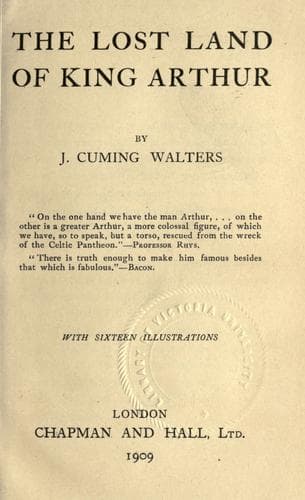
Arthur, King -- Homes and haunts -- England -- Cornwall (County); Cornwall (England : County) -- Antiquities, Celtic
These chroniclers were Gildas and Nennius, of whom no very certain
biographical facts can be discovered, though the latter is said to have
been a monk at Bangor. Gildas is the reputed author of a treatise, _De
Excidio Britanniæ_, blindly copied by Bede, which supplied a history
of Britain from the time of the Incarnation to the year 560 A.D. But
darkness enshrouds the historian, of whose country, parentage, and
period much is surmised and little is discoverable. The erudite author
of _Culture in Early Scotland_, Dr. Mackinnon, believes that the writer
of the gloomy and pessimistic work on the destruction of Britain was
a Romanised Briton, who migrated to Brittany to escape the pitiless
severity of the Saxons, and there founded the monastery of Ruys. It
has even been claimed that Gildas was a native of Clydesdale, and if
this were so another link would exist to connect Arthur himself with
Scotland, for the historian was so closely identified with the race
and the cause championed by that king that his surname was taken from
Arthur’s famous battle of Badon, which, again, is said by some to have
been fought in the Lowlands.[2] Gildas was the wisest of the Britons
according to Alcuin, and Dr. Mackinnon thinks that his chronicle
should be accepted as authentic, in spite of its occasional errors
and its undoubted bias. The stern character of the writer is evinced
by his denunciations not only of Saxon excesses, but of the clerical
vices of his age. In short, Gildas was a religious devotee, an austere
and uncompromising critic of the demoralising customs of the time; a
species of prophet, also, who saw in corruption and degeneration the
signs of coming destruction for the race to which he belonged. Roman
influence had undermined the morals of the people and enervated public
and social life. The story Gildas tells is one of unrelieved gloom, but
it stands out in contrast to other narratives by its rugged simplicity
and its freedom from the more romantic elements. Murder, sacrilege, and
immorality were bringing about wholesale desolation, and the patriotic
Gildas saw no future before his country but absolute ruin and racial
extinction. His allusions to Arthur are scanty, incidental, and none
too complimentary, and they have assumed importance only as bases for
the construction of bold theories by subsequent writers.
Public-domain text, read in full here on John Shaqi.
Reviews
Reviews
No reviews yet
Be the first to share your thoughts on this work.
Join the Discussion
Join the discussion
Sign in to leave a comment or review.
Sign InorCreate an account