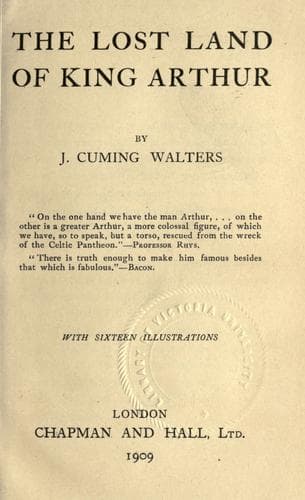
Arthur, King -- Homes and haunts -- England -- Cornwall (County); Cornwall (England : County) -- Antiquities, Celtic
Joseph during an imprisonment of forty-two years; the fisherman king,
Pelleas, needed no food while it was in his keeping. This is set forth
in Wolfram’s “Parzival”--
“Whate’er one’s wishes did command,
That found he ready to his hand.”
Wolfram von Eschenbach, to whom both Germans and English owe so much,
found a collection of badly joined fables which he turned into an epic,
making Parzival (Perceval) the hero and the Grail quest the central
incident. Wolfram knew nothing of Joseph of Arimathæa; but Mr. Alfred
Nutt has pointed out that the Joseph form of the Grail story and the
Perceval form may really form one organic whole, or the one part may
be an explanatory after-thought. Whether the Christian element was
influenced by Celtic tradition, or whether the Christian legend was
superimposed upon the Celtic basis, is the subtle point which few care
to say is decided. The suggestion has been thrown out that the Grail
legend may even be of Jewish origin, and that in singing of their Holy
City whose walls should be called “salvation,” whose gates “praise,”
and whose “stones should be laid in fair colours,” they supplied the
germ from which in mediæval ages the Grail-myth sprang. The Grail was
an article of strong belief with the Templars who worshipped the head
of John the Baptist, which was reported to have been found in the
fourth century, to have kept an Emperor from dying at Constantinople,
and to have provided nourishment for all who were engaged upon
religious crusades. The idea of the Holy City seems again to recall the
aspiration of the Templars, and the Sarras of romance may have been
none other than Jerusalem. Mr. Nutt has been able to adduce Celtic
parallels for all the leading incidents in the romance of the Grail,
while the many inconsistencies in the versions are explained by the
fusion of two originally distinct groups of stories. It is, as Mr.
Nutt aptly says, the Christian transformation of the old Celtic myths
and folk-tales which “gave them their wide vogue in the Middle Ages,
which endowed the theme with such fascination for the preachers and
philosophers who use it as a vehicle for their teaching, and which has
endeared it to all lovers of mystic symbolism.”
Public-domain text, read in full here on John Shaqi.
Reviews
Reviews
No reviews yet
Be the first to share your thoughts on this work.
Elsewhere in the archive
Join the Discussion
Join the discussion
Sign in to leave a comment or review.
Sign InorCreate an account