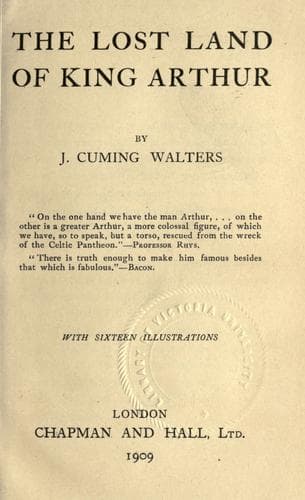
Arthur, King -- Homes and haunts -- England -- Cornwall (County); Cornwall (England : County) -- Antiquities, Celtic
We turn instinctively to Tennyson for the poetisation of this incident.
No one has worked on the legends so wondrously as he, no one has
added more to their moral significance or to their mysticism. His
paraphrase of the prose of Malory, his additions to the details, and
his glorification of the vision, rank among the greatest triumphs of
his peculiar art.
With what feelings is one likely to read his _Holy Grail_, and,
standing near the broken and gleaming torrent of St. Knighton’s Kieve,
try to imagine that the marvellous quest which ended in Sarras began at
this spot?
CHAPTER IX
OF CAMELFORD AND THE LAST BATTLE
“O’er Cornwall’s cliffs the tempest roar’d,
High the screaming sea-mew soar’d;
On Tintagel’s topmost tower
Darksome fell the sheeting shower;
Round the rough Castle shrilly sung
The whirling blast, and wildly flung
On each tall rampart’s thundering side
The surges of the tumbling tide:
When Arthur ranged his red cross ranks
On conscious Camlan’s crimson banks.”
WHARTON, _The Grave of King Arthur_.
“On Trinitye Mondaye in the morne
This sore battayle was doomed to be;
Where many a knight cry’d ‘Well-a-waye!’
Alacke, it was the more pittie.”
_Percy Reliques._
Sheer over the bleak Cornish hills, fifteen miles from Launceston,
lies a small white-looking town with a precipitous highway along which
the principal houses and one or two poor-looking public buildings
are ranged. It is a town without a church, and, except on market
day, without the signs of stirring life and business; a remote and
isolated little place which nevertheless once had its own Parliamentary
representative and not unfittingly chose “Ossian” Macpherson as its
member. This is Camelford, and the ride by coach from Launceston is not
uninteresting or uninstructive. The desolate aspect of the land, the
poverty-stricken appearance of the few tiny villages passed on the way,
the barrenness of the hills, the scantness of the population, all serve
to reveal the history, past and present, of this portion of England
where only the hardiest of the race could live, and live somewhat
precariously. The land itself yields little; there are no rivers upon
which a boat could be used, and the line of rough hills which form
the spine of the county pent the people as within a prison. Even now,
Camelford and half a score of like places seem shut out of the world.
The stream of life is sluggish, luxuries are scarcely known, the habits
of the villagers are primitive, and yet the Cornishmen retain that
rugged independence for which they have at all times been noted. In old
times the county produced a race of heroes and giants who preserved
their liberties and were among the last to be subdued by English
rulers. Both modern and ancient history, legends and facts, bear
testimony to the constant struggle which prevailed in this part, and
had there been no “giants” in Cornwall, neither its traditions nor its
history would be what they are.
Public-domain text, read in full here on John Shaqi.
Reviews
Reviews
No reviews yet
Be the first to share your thoughts on this work.
Elsewhere in the archive
Join the Discussion
Join the discussion
Sign in to leave a comment or review.
Sign InorCreate an account