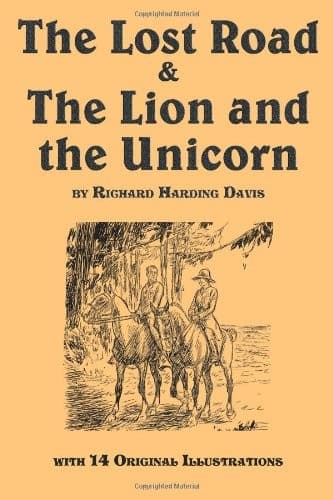
Produced by Marleen Hugo. HTML version by Al Haines.
THE LOST ROAD
THE NOVELS AND STORIES OF
RICHARD HARDING DAVIS
TO
MY WIFE
Contains:
THE LOST ROAD
THE MIRACLE OF LAS PALMAS
EVIL TO HIM WHO EVIL THINKS
THE MEN OF ZANZIBAR
THE LONG ARM
THE GOD OF COINCIDENCE
THE BURIED TREASURE OF COBRE
THE BOY SCOUT
SOMEWHERE IN FRANCE
THE DESERTER
AN INTRODUCTION BY
JOHN T. McCUTCHEON
WITH DAVIS IN VERA CRUZ, BRUSSELS, AND SALONIKA
In common with many others who have been with Richard Harding Davis as
correspondents, I find it difficult to realize that he has covered his
last story and that he will not be seen again with the men who follow
the war game, rushing to distant places upon which the spotlight of
news interest suddenly centres.
It seems a sort of bitter irony that he who had covered so many big
events of world importance in the past twenty years should be abruptly
torn away in the midst of the greatest event of them all, while the
story is still unfinished and its outcome undetermined. If there is a
compensating thought, it lies in the reflection that he had a life of
almost unparalleled fulness, crowded to the brim, up to the last
moment, with those experiences and achievements which he particularly
aspired to have. He left while the tide was at its flood, and while he
still held supreme his place as the best reporter in his country. He
escaped the bitterness of seeing the ebb set in, when the youth to
which he clung had slipped away, and when he would have to sit
impatient in the audience, while younger men were in the thick of
great, world-stirring dramas on the stage.
This would have been a real tragedy in "Dick" Davis's case, for, while
his body would have aged, it is doubtful if his spirit ever would have
lost its youthful freshness or boyish enthusiasm.
It was my privilege to see a good deal of Davis in the last two years.
He arrived in Vera Cruz among the first of the sixty or seventy
correspondents who flocked to that news centre when the situation was
so full of sensational possibilities. It was a time when the American
newspaper-reading public was eager for thrills, and the ingenuity and
resourcefulness of the correspondents in Vera Cruz were tried to the
uttermost to supply the demand.
In the face of the fiercest competition it fell to Davis's lot to land
the biggest story of those days of marking time.
The story "broke" when it became known that Davis, Medill McCormick,
and Frederick Palmer had gone through the Mexican lines in an effort to
reach Mexico City. Davis and McCormick, with letters to the Brazilian
and British ministers, got through and reached the capital on the
strength of those letters, but Palmer, having only an American
passport, was turned back.
Public-domain text, read in full here on John Shaqi.
Reviews
Reviews
No reviews yet
Be the first to share your thoughts on this work.
Join the Discussion
Join the discussion
Sign in to leave a comment or review.
Sign InorCreate an account