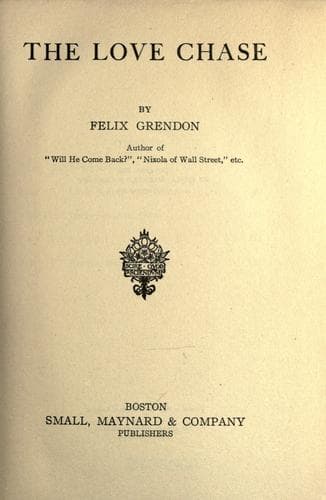
New York (N.Y.) -- Social life and customs -- 20th century -- Fiction
"Ah, now you’re coming to it. For weeks past, I’ve been saturating my
mind with radical literature. Tons of it. From professional motives
solely, of course. After a studious and impartial consideration of
facts and principles, I’ve come to a very curious pass."
"You don’t mean to say that you’ve been converted!" said Robert, rising
excitedly from his chair.
"Yes, I’ve been converted. Not to radicalism, mind. Personally, I’m a
firm believer in the aristocratic state as championed by Plato, Ruskin,
and Carlyle, the state in which the Government is carried on by those
whose equipment best fits them to govern. We’ll reach this state—in
about a thousand years. Meanwhile, I’ve been converted not to
radicalism, but to the view that the radicals are right in theory and
the Government wrong in practice; the former right in demanding a
complete restoration of civil liberty and an enormous grant of
industrial liberty, the latter wrong in thwarting these demands."
After a few moments spent in digesting Pryor’s astonishing admissions,
Robert said:
"One good surprise deserves another."
"Fire away."
"I’ve just inherited two million dollars!"
Pryor was stupefied.
"Where the blue blazes did you get it from?" he cried, his long neck
rising telescopically out of his stand-up collar.
"That’s one piece of information that hasn’t drifted your way, at all
events," said Robert, taking a malicious pleasure in Pryor’s
stupefaction.
A marked pause followed. Then Pryor, having congratulated Robert, said
abruptly:
"As far as I can see, nothing now stands in the way of your marriage to
Charlotte Beecher."
"What do you mean?"
Searching glances were exchanged. Each recognized in the other a man of
rare talent and unusual probity, and trusted him accordingly. Pryor
took the plunge.
He remarked quietly that, during Robert’s absence abroad, he and
Charlotte had become very good friends. He was well aware of her intense
attachment to Robert. She had, in fact, talked about it freely and
frankly to him. Thus he knew that she had taken the initiative in
proposing marriage to Robert, a very natural step, inasmuch as she was
in the vastly superior position. He knew, however that Robert had
refused on the ground of the extreme inequality of their circumstances.
With the best will in the world, Robert found it difficult to reply.
Habit and custom were strong against a ventilation of his refusal and of
the real reasons underlying it.
"The truth is," he said, after a second’s hesitation, "Charlotte and I
would be very poor partners on a long dull grind, and this is what
modern marriage has become. We’re excellent friends. We put a fine edge
on each other’s faculties. When we meet, the blue sparks fly. In fact,
they fly too much."
Public-domain text, read in full here on John Shaqi.
Reviews
Reviews
No reviews yet
Be the first to share your thoughts on this work.
Elsewhere in the archive
Join the Discussion
Join the discussion
Sign in to leave a comment or review.
Sign InorCreate an account