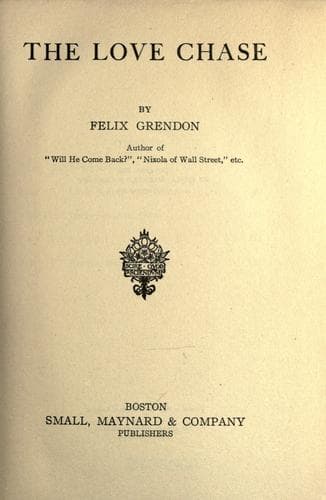
New York (N.Y.) -- Social life and customs -- 20th century -- Fiction
"Percival said it behooved us to show that free love could rise above
the lustful impulses of the flesh. We were to come to each other clean,
so as not to do the cause of free love an injury."
England had been the Paradise of her hopes, but it proved their
sepulchre. Scarcely had they docked in the Mersey when reporters
representing news associations accosted them for information about their
"elopement." The news had been cabled from New York, where they were
featured as "elective affinities." In London, too, they found
themselves headliners in the yellow journals. Needless to say, the most
extreme construction was put on their journey together. And the
escapade of "affinity Houghton" became an international sensation.
"How did it leak out, Cornelia?" exclaimed Janet. "Had you told anyone
you were going together?
"Not a soul. But my connection with a newspaper was fatal. A woman
journalist is subject to more gossip than an actress. Every time she’s
seen with a new man, she’s reported to have ensnared a new lover."
As a result of this glaring notoriety, Cornelia went on, Houghton’s
manner toward her underwent a radical change. He remained kind and
courteous, but his manner grew cool. He urged one pretext after another
for postponing what was to have been a historic interview with his wife.
In London he took her to a hotel and left her there alone.
Two days later she received a letter from him, in which he said that his
wife was unalterably resolved to contest a divorce on any ground, and
that the newspaper gossip had almost irretrievably injured his
prospects. He added that he was as devoted to her as ever. He was, in
fact, broken-hearted, but his clear duty to his family, his children and
his career demanded that they should never meet again.
In spite of this note she made several attempts to see him once more.
She confessed to Janet that she had been ready to accept any terms he
might make, if only he agreed not to part from her forever. It was for
love and not for marriage that she had sacrificed herself. It was not
marriage but love that she demanded. But he sustained his pitilessly
inflexible attitude. Almost prostrated by the notoriety which the
experience had thrust upon her, she made a heart-broken return to the
United States.
"I landed in New York without hope, without health, and without a home,"
said Cornelia, dramatically. "But I had vindicated my belief that love
should be free."
To forestall a social boycott, she had proudly decided to shun all her
former friends. To this end she rented a flat in the Lorillard
tenements. And here she had remained in eclipse, and in receipt of a
small allowance from a brother who was a leading politician in a Western
State.
Latterly, old friends of hers, members of the fellowship of Outlaws, had
drifted into her rooms in Kips Bay; and so she had been
dragged—unwillingly, she alleged—from her retirement.
Public-domain text, read in full here on John Shaqi.
Reviews
Reviews
No reviews yet
Be the first to share your thoughts on this work.
Join the Discussion
Join the discussion
Sign in to leave a comment or review.
Sign InorCreate an account