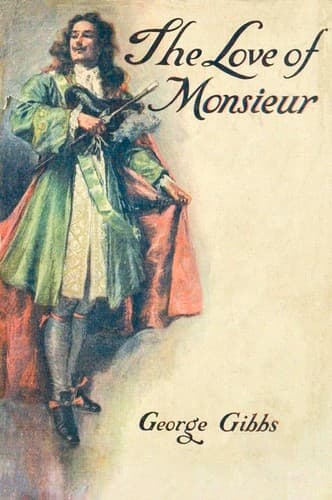
Adventure stories; French -- England -- Fiction; Great Britain -- History -- Charles II, 1660-1685 -- Fiction; Love stories
“Messieurs,” said Mornay, smiling quizzically, “your servitor.” He
stopped again. “I thought my name was spoken. No?” He looked from one
to the other. “My name I comprehend, but, messieurs, my titles--my new
titles! To whom am I indebted for my titles? Ah, Monsieur le Capitaine
Ferraire, _mon ami_, I am glad that you are here. I thought that I had
fallen among enemies.”
He laughed gayly. It was rippling and mellow, a laugh from the very
cockles of the heart, full of the joy of living, in which there lurked
no suspicion of doubt or insincerity--the situation was so vastly
amusing. Cornbury laughed, too. He was an Irishman with a galloping
humor; nor was Downey slow to follow his example.
For Heywood and Ferrers it was another matter. The elder man sat
rigidly, glaring at the Frenchman with eyes that glittered from lids
narrow with hate. Ferrers, disconcerted by the defenselessness of the
Frenchman, sat stupidly, his features swollen with rage, his lips
uncertain and trembling for a word to bring the quarrel to a head. But
before he could speak, Sir Henry Heywood, very pale, had thrust himself
forward over the table to Mornay in a way not to be mistaken, and said,
briefly:
“Gad, sirrah, your laugh is the sign of an empty mind!”
Mornay was truly taken by surprise. But as he looked up at this new
enemy he found no difficulty in understanding Heywood’s meaning. He
rose to his feet, still smiling, and said, coolly, with a sedulous
politeness:
“I am empty of brains? It takes a wit like that of monsieur to discover
something which does not exist.”
Captain Ferrers had floundered to his feet, blustering and maddened
at being cheated out of his quarrel. He burst violently upon the
colloquy, and, seizing Heywood by the arm, dragged him back to the
window-seat.
“’Tis not your quarrel, Heywood,” he began.
But Sir Henry shook himself free of Ferrers, and they both faced
Monsieur Mornay, who, somewhat languidly, but with a polite tolerance,
stood leaning against the table watching this unlooked for development
of the drama.
“Messieurs,” he smiled, “an _embarras de richesse_. Never have I been
so greatly honored. I pray that you do not come to blows on my account.
_One_ of you might kill the _other_, which would rob _me_ of the honor
of killing you _both_.”
Captain Cornbury until this time had been an interested and amused
onlooker. He dearly loved a fight, and the situation was enjoyable; but
here was the evening flying and his game of cards gone a-glimmering.
“Zounds, gentlemen!” he broke in. “A pretty business--to fight at the
Fleece Tavern. Pleasant reading for the _Courant_--a fitting end to a
comedy begun upon the street.”
“’Tis not your quarrel, Cornbury,” growled Ferrers.
“Nor yours, Ferrers,” said Heywood, coldly.
“You see, monsieur,” said Mornay to Downey, with mock helplessness,
“there is no help for it.”
Cornbury swore a round oath:
Public-domain text, read in full here on John Shaqi.
Reviews
Reviews
No reviews yet
Be the first to share your thoughts on this work.
Join the Discussion
Join the discussion
Sign in to leave a comment or review.
Sign InorCreate an account