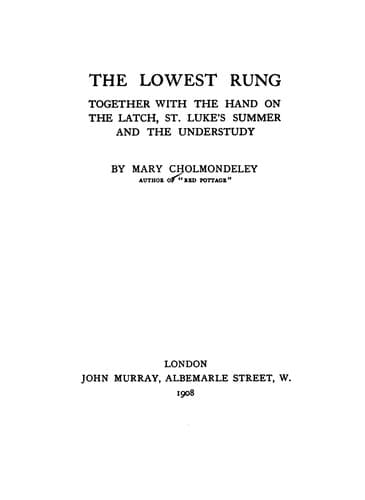
The Lowest Rung: Together with The Hand on the Latch, St. Luke's Summer and The UnderstudyCholmondeley, Mary
General
The Lowest Rung: Together with The Hand on the Latch, St. Luke's Summer and The Understudy
Cholmondeley, Mary
Short stories, English
Oui, sans doute, tout meurt: ce monde est un grand reve,
Et le peu de bonheur qui nous vient en chemin,
Nous n'avons pas plus tot ce roseau dans la main,
Que le vent nous l'enleve.
"Que le vent nous l'enleve." She repeated the last words to herself. Ah
no! the wind could not take her happiness out of her hand.
A wandering wind had risen at nightfall, and it came softly across the
snow, and tried the doors and windows as with a furtive hand. She could
hear it coming as from an immense distance, passing with a sigh,
returning plaintive, homeless, forlorn, to whisper round the house.
J'ai vu sous le soleil tomber bien d'autres choses
Que les feuilles des bois, et l'ecume des eaux,
Bien d'autres s'en aller que le parfum des roses
Et le chant des oiseaux.
That wind meant more snow. Involuntarily she laid down her book and
listened to it.
How like the sound of the wind was to wandering footsteps, slowly
drawing near, creeping round the house. She could almost have fancied
that a hand touched the shutters, was even now trying to raise the latch
of the door.
A moment of intense silence, in which the wind seemed to hold its breath
and listen without, while she listened within. And then a low, distinct
knock upon the door.
She did not move.
"It is the wind," she said to herself; but she knew it was not.
The knock came again, low, urgent, not to be denied.
She had become very cold. She had supposed fear was an emotion of the
mind. She had not reckoned for this slow paralysis of the body.
She managed to creep to the window and unbar the shutter an inch or two.
By pressing her face against the extreme corner of the pane she could
just discern in the snowlight part of a man's figure, wrapped in a long
cloak.
She barred the window once more. She was not surprised. She knew now
that she had known it always. She had pretended to herself that the
thief would not come; but she was expecting him when he knocked. And he
stood there, outside. Presently he would be inside.
He knocked yet again, this time more loudly. What need was there for
silence when for miles and miles round there was no ear to hear save
that of a chance prairie dog?
She laid hold upon her courage, seeing that it was her only refuge, and
went to the door.
"Who is there?" she said through a chink.
A man's voice, low and feeble, replied, "Let me in."
"I cannot let you in."
There was a short silence.
"I pray you, let me in," he said again.
"I have told you I cannot. Who are you?"
"I am a soldier, wounded. I'm trying to get back to my friends at ----."
He mentioned a settlement about fifty miles north. "I have missed my
way, and I can't drag myself any farther."
Her heart swung violently between suspicion and compassion.
"I am alone in the house," she said. "My husband is away, and he made me
promise not to let any one in on any pretence whatever during his
absence."
Public-domain text, read in full here on John Shaqi.
Reviews
Reviews
No reviews yet
Be the first to share your thoughts on this work.
Join the Discussion
Join the discussion
Sign in to leave a comment or review.
Sign InorCreate an account