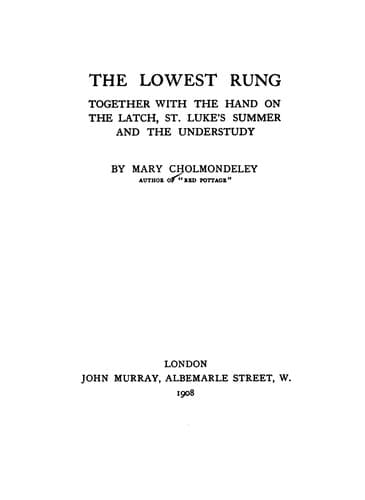
The Lowest Rung: Together with The Hand on the Latch, St. Luke's Summer and The UnderstudyCholmondeley, Mary
General
The Lowest Rung: Together with The Hand on the Latch, St. Luke's Summer and The Understudy
Cholmondeley, Mary
Short stories, English
But all this time, while I have been giving a free rein to my
autobiographic instincts, the question still remains unanswered, Why is
human nature so prone to think it has been travestied that it becomes
impervious to reason on the subject the moment the idea has entered the
mind? Once lodged, I have never known such an idea dislodged, however
fantastic. Why is it that if, like Mrs. Clifford, one has the good
fortune to evolve a type, no one can believe it is not an individual?
Why does not the outraged friend console himself with the remembrance
that if he is one of many others who are feeling equally harrowed, he
cannot really be the object of a malignant spite, carefully disguised
till then under the apparel of a cheerful friendship?
I think an answer--a partial answer--to the latter question may be found
in the fact that balm was never yet poured on a wounded spirit by the
assurance that there are thousands of others exactly like itself. We can
all endure to be lampooned. (I have even known a man who was deeply
disappointed when he was forced to believe that he had not been
victimised.) But to be told we are one of a herd! This flesh and blood
cannot tolerate. It is unthinkable; a living death. That we who "look
before and after," and "whose sincerest laughter with some pain is
fraught"; that _we_, lonely, superb, pining for what is not,
misunderstood by our nearest and dearest, who don't know, and never
_can_ know
Half the reasons why we smile or sigh
(unless, indeed, we are autobiographists: then they know _all_ the
reasons)--that WE should be confused with the vast mob of foolish,
sentimental spinsters, or pedantic clerics, or egotistic old bachelors!
Away!--away! The reeling mind stops its ears against these obscene
suggestions.
The only alternative which remains is that an unscrupulous novelist has
_heard_ of us--nothing more likely--without being actually acquainted
with us, and has listened to garbled accounts of us from our so-called
friends; or has actually met us at a bazaar or a funeral, though of
course he professes to have forgotten the meeting; has been impressed
with our subtle personality--nothing more likely--has felt an envious
admiration of what we ourselves value but little--our social charm--and
has yielded--nothing more likely--to the ignoble temptation of
caricaturing qualities which he cannot emulate. Or perhaps he has known
us for years, and has shown a mysterious indifference to our society, an
impatience of our deeper utterances, which we can now, _at last_, trace
to its true source, a guilty consciousness of premeditated treachery
which has led him to strike us in a dastardly manner, which we can
indeed afford--being what we are--to forgive, but which we shall never
forget. And if an opportunity offers later on, it is possible that an
unprejudiced and judicial mind may feel called upon to indicate what it
thinks of such conduct.
Public-domain text, read in full here on John Shaqi.
Reviews
Reviews
No reviews yet
Be the first to share your thoughts on this work.
Join the Discussion
Join the discussion
Sign in to leave a comment or review.
Sign InorCreate an account