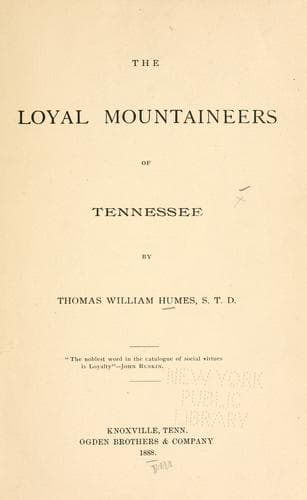
The loyal mountaineers of TennesseeHumes, Thomas William
Philosophy
The loyal mountaineers of Tennessee
Humes, Thomas William
Tennessee, East -- History -- Civil War, 1861-1865
“A more interesting region, or one more entitled to our most active
sympathy, is not to be found within the limits of the United States.
Forming a part of the noble State of Tennessee, it is in many
respects a State in itself, and not a small one either. It consists
of the broad valley of the magnificent river, which traverses it from
northeast to southwest, three hundred miles in length, and with a
varying width of from fifty to seventy-five miles--and of the slopes
of the mountains, which separate it on the north from Kentucky, on
the southwest from Middle Tennessee, and on the southeast from North
Carolina and Georgia: a beautiful valley, between beautiful enclosing
hills, fertile many of them to their summits, sparkling with a
hundred tributaries to the noble stream which forms its principal
feature.
“That river is in some respects one of the most remarkable on the
continent. Its northern affluents rise in the State of Virginia, but,
as if to read a lesson of patriotism in the very face of the soil,
as if to prop the fabric of the Union by the eternal buttresses of
the hills, instead of flowing to the Atlantic like the other rivers
of Virginia, it gathers up the waters of its tributary streams,
Holston and Clinch and French Broad, and connecting Virginia and
the Carolinas with East Tennessee, flows southward down to the
northwestern corner of Georgia. There, after kissing the feet of the
glorious hills of Chattanooga, instead of flowing to the Gulf, its
seeming natural direction, it coquets with Northern Alabama, breaks
into the Muscle Shoals, plants Decatur at their head and Florence at
their feet, and then sweeping back to its native North, traverses
the entire width of Tennessee a second time, apparently running up
hill--for while it is flowing northward, the Mississippi, parallel to
it, and at no great distance, is rolling its floods southward--enters
the State of Kentucky, and empties into the Ohio, fifty miles above
the junction of that river with the Mississippi, thus binding seven
States in its silver circuit, and connecting them all with the great
central basin of the continent.
“The soil of Eastern Tennessee is rich; the mountains are filled
with coal and almost every variety of ore; their slopes bubble
with mineral springs; the climate is temperate and healthful; the
territory divided into farms of a moderate size, for the most part
tilled by frugal, industrious men, who own the soil, which yields
them its well-earned abundance. In no part of the State are there so
few slaves; in none is there a more substantial population; in no
part of the South is the slave interest so feeble. East Tennessee
greatly resembles the lower ranges and fertile valleys of the Alps,
and it has been often called the American Switzerland. It is divided
into thirty counties, and its population does not, I think, fall
short of 300,000 souls.[4]
Public-domain text, read in full here on John Shaqi.
Reviews
Reviews
No reviews yet
Be the first to share your thoughts on this work.
Join the Discussion
Join the discussion
Sign in to leave a comment or review.
Sign InorCreate an account