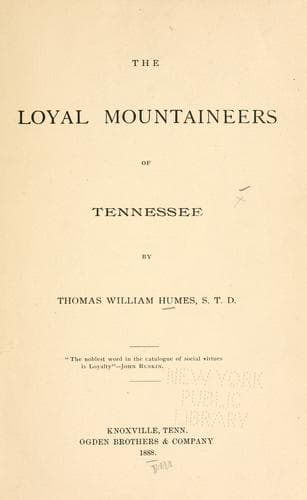
The loyal mountaineers of TennesseeHumes, Thomas William
Philosophy
The loyal mountaineers of Tennessee
Humes, Thomas William
Tennessee, East -- History -- Civil War, 1861-1865
As for current literature and science, periodicals and new books,
they found no access at all to the place from abroad. The only
volumes recently published, copies of which had circulation were,
“A Strange Story,” by Bulwer, and a translation of Victor Hugo’s
“Les Miserables.” These had been re-printed at Richmond, and were
remarkably inferior in their mechanical execution. The paper on
which they were printed and the typography vied in poverty and
unhappiness. The covering was of wall-paper with very large figures,
the mutilation of which, in adapting the binding to its use, added to
the grotesque appearance of the books.
News was still given by authority. The community would be told of a
battle somewhere, in which many “Yankees” were killed, wounded and
taken prisoners, and the Confederate losses were relatively small.
These reported victories, with their great disparities in results,
occasioned, as did the news from Corinth, much open joy on the one
hand and secret incredulity on the other. They who doubted and
still clung to the Union, although reduced in numbers, were not so
crushed in spirit as to sulk, Achilles like, in their tents, but
they sought one another’s company, listened to news from the United
States, brought in by adventurous runners, discussed the situation
and probabilities, and encouraged each other to steadfastness.
Sometimes the national heavens wore to them an intense gloom,
relieved by but few dim rays of hope. But at one time their hope
grew very bright, only to suffer a fatal eclipse. No occurrence of
the war gave the Union people of East Tennessee such disappointment
as the failure of General McClellan’s Peninsular campaign. In their
imaginations, “Little Mack” was the hero of the epoch, the Alexander
who would cut the Gordian knot of the rebellion, the American Cæsar
who would shortly capture the insurgents’ capital and proclaim to the
nation, “_Veni, vidi, vici_.” And when they learned the campaign’s
result, they did so with more grief and discouragement than was felt
elsewhere in the land, because of their isolation from sympathy and
their unfriendly environment.
Public-domain text, read in full here on John Shaqi.
Reviews
Reviews
No reviews yet
Be the first to share your thoughts on this work.
Elsewhere in the archive
Join the Discussion
Join the discussion
Sign in to leave a comment or review.
Sign InorCreate an account