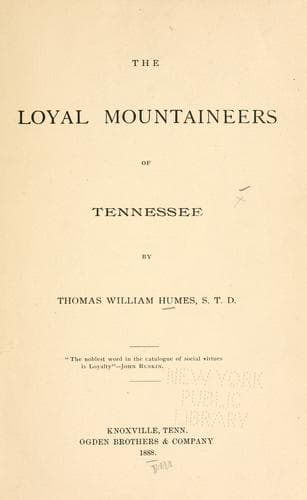
The loyal mountaineers of TennesseeHumes, Thomas William
Philosophy
The loyal mountaineers of Tennessee
Humes, Thomas William
Tennessee, East -- History -- Civil War, 1861-1865
In the great majority of instances, friendly social intercourse
between people of hostile opinions had ceased, but there were
exceptions to the rule. Early in May, 1863, a civilian who was firm
in his devotion to the Union, but strong also in his attachment to
personal kinsmen, and equally free in manifesting both, had a number
of invited guests to dine with him one day. News of the death of
Gen. Stonewall Jackson had but just arrived, and the sorrowful
event was a topic of conversation at the table. The hero who had
recently departed, has been since the war ended, an object of
reverent admiration to some people who cared nothing for or detested
secession, as well as to all who sympathized with it. While the
bloody conflict was going on, the godliness which was a strong trait
in his character, seemed to sanctify altogether in the view of some
minds, the cause for which he fought so bravely and skillfully.
They would, no doubt, have stoutly rejected the dogma of works of
supererogation. But the religious merits of General Jackson appeared
to more than counterbalance with them all religious demerits of
others who sought with him to dissolve the Union. In the conversation
just mentioned, pertinent expressions were given of esteem for the
deceased and of regret for his death. After these had been spoken a
young man at the table exclaimed:
“I have no doubt that General Jackson is now commanding a legion of
angels in heaven!”
This sentimental climax to the panegyrics before uttered, somewhat
startled its hearers, and seemed to forbid any remark that might
even imply dissent. The prevailing silence was broken by one of the
company relating an anecdote of the Rev. David Nelson, who had been
for years a doctor of medicine. From being a downright religious
sceptic, he had been converted to the Christian faith, had become a
prominent Presbyterian minister in East Tennessee, and was the author
of a book entitled, “The Cause and Cure of Infidelity,” which once
had a very extensive circulation. He was in Washington City during
the presidency of Andrew Jackson, who, hearing of his presence in the
city, sent him an oral invitation to visit him at the White House.
The two had been well known to each other in former years and were
personal friends, but Dr. Nelson said, in narrating the incident,
he had found after becoming a Christian minister, little or no
benefit to result from his social visits to men in high places of
the State or Nation. He therefore did not make the proposed visit.
The President then sent him a written request to go and see him, and
Dr. Nelson went. General Jackson had lost his wife by death, and the
affliction had been the means of leading him to serious reflection
and to faith in Christ--to baptism and membership in the Presbyterian
Church. As a consequence, the conversation that ensued between him
and his reverend visitor, was of a religious nature. Dr. Nelson, in
speaking afterwards of the interview, said:
Public-domain text, read in full here on John Shaqi.
Reviews
Reviews
No reviews yet
Be the first to share your thoughts on this work.
Elsewhere in the archive
Join the Discussion
Join the discussion
Sign in to leave a comment or review.
Sign InorCreate an account