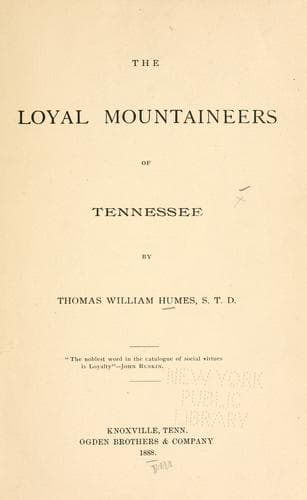
The loyal mountaineers of TennesseeHumes, Thomas William
Philosophy
The loyal mountaineers of Tennessee
Humes, Thomas William
Tennessee, East -- History -- Civil War, 1861-1865
“_Forgiveness to those who killed him?_” Let the question in all its
bearings of responsibility for his death, be referred for answer to
the Son of Man, whom God has appointed to judge the quick and dead!
Meanwhile, let thy dismembered body, O, Pleasant Miller McClung,
sleep on in the quiet grave of thy early manhood, until the morning
of the resurrection of the dead! Then shalt thou meet those for whom
thou didst pray forgiveness. And surely, thy unstudied petition was
so like one that passed from the pale lips of the Man of Sorrows
when expiring on the cross, that it must have gone up through Him
to the throne of eternal grace. Sleep on, then, until that coming
day! Multitudes, equally brave--wearing the blue or the gray--fell
on sleep in the same mighty conflict. In many and crowded cemeteries
the grass grows on lowly mounds over them, the white and pulseless
marble glints in the shine of the sun as it rises and sets, and the
birds sing their peaceful requiem in the air. And shall they not--a
grand army, hundreds of thousands strong--come again to life? What if
some are in unmarked graves? What if some graves have headstones that
bear the sorrowful word, “Unknown?” _God knoweth!_ And they shall
rise again, for He has said it. But if, in the generations hereafter,
“Columbia” is indeed “to glory arise,” O ye, her sons, heed well
the lesson taught by the war between her children in ’61-65. “The
beginning of strife is as when one letteth out water, therefore leave
off contention, before there be quarreling.”
In this Republic the avenues to employment are so many and wide
open, that some measure of success awaits all who have capacity and
diligence. Justly enough, a poor and obscure lineage does not prevent
the rise to eminence or wealth of him who is worthy, nor are they to
be attained by the son of rich or notable parents, who has no merit
of his own. “Parson Brownlow,” in writing once for the public about
some of his enemies to whom he attributed aristocratic pretensions,
compared them to “turnips, the better part of which is under
ground.” Still, wisely enough, men generally even under Democratic
institutions, count an honest and industrious ancestry of some worth.
By common consent, sons are to be commended who copy the virtues and
good conduct of their fathers. One of the guests at a dinner party
in Knoxville given to Gen. Burnside, said to him: “Andrew Johnson
deserves great credit for having risen from poverty and obscurity to
honorable distinction in the country.” The General was expected to
reply in just the same strain of sentiment. His answer was: “Yes!
but so does every man who inherits superior advantages and uses them
wisely and faithfully.” And there are strong temptations to idleness
and improvidence besetting the young man who is born to affluence and
favorable opportunities, which it is meritorious in him to overcome,
and with which the poor boy has never to struggle.
Public-domain text, read in full here on John Shaqi.
Reviews
Reviews
No reviews yet
Be the first to share your thoughts on this work.
Elsewhere in the archive
Join the Discussion
Join the discussion
Sign in to leave a comment or review.
Sign InorCreate an account