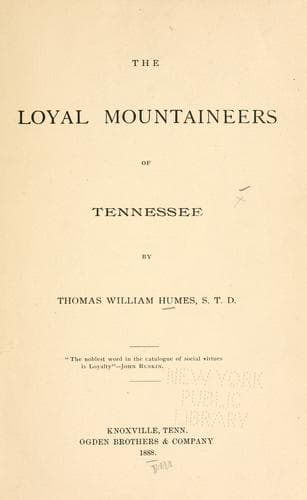
The loyal mountaineers of TennesseeHumes, Thomas William
Philosophy
The loyal mountaineers of Tennessee
Humes, Thomas William
Tennessee, East -- History -- Civil War, 1861-1865
The genealogical facts concerning the young Captain who met his
death on Summit Hill during the “Sanders raid” are interesting,
for he was the only living man in whom met lines of descent from
two persons distinguished in the earliest history of Tennessee and
Knoxville. He was the great grandson of William Blount, Governor
of the Territory south of the Ohio, from 1792 to 1796, and also of
James White, founder of Knoxville, (the capital of the Territory) and
fellow-worker of Blount in the organization of Tennessee.
Col. Sanders, after one hour’s passage at arms with the Confederates
under the command _pro tem._ of Col. R. C. Trigg, took up his line
of march eastward and burned the bridges at Strawberry Plains and
Mossy Creek. He captured stores and prisoners at several places, and
was finally compelled to withdraw hastily to Kentucky. His enemy
pressed him closely on all sides, and to avoid capture, he had to
pass the mountain by an unfrequented gap, (Smith’s) through which
there was no road, but only a bridle path, to follow. Reports made by
the respective parties in the conflict, are appended in a condensed
form.[31]
When the excitement occasioned by Sanders’s visit had passed away,
Knoxville returned to its former quiet condition and remained so for
two months.
Meanwhile, the United States forces which held Cumberland Gap were
in turn compelled by their adversaries to evacuate it, because of
insufficient supplies.
CHAPTER XIII.
GEN. BUCKNER’S RETREAT--A CITIZEN’S ADVENTURE--GEN. BURNSIDE;
HIS WELCOME; HIS EXPEDITION--CUMBERLAND GAP; ITS SURRENDER--AN
ECCENTRIC FARMER--MILITARY MOVEMENTS IN EAST TENNESSEE--FIGHT AT
BLUE SPRINGS--AFFAIRS AT AND NEAR LOUDON--BURNSIDE AND THE PEOPLE.
“Now is the winter of our discontent
Made glorious summer by this sun of York;
And all the clouds that lowered upon our house,
In the deep bosom of the ocean buried.”
SHAKS.: _Richard III._
Gen. Buckner had been for some time at Knoxville in command of the
military department of Kentucky, Middle and East Tennessee, North
Alabama and Southwest Virginia. His personal presence was commanding
and adapted to fill the popular notion of a grand army officer. The
attention of citizens was attracted and their criticism challenged by
his imposing appearance, as he rode without escort upon a splendid
charger through the principal street. His reputation was that of a
true gentleman and a soldier of superior merit. The public esteem had
been drawn to him, by his conduct at the fall of Fort Donelson, in
comparison with that of his companion-generals, especially Floyd.
Public-domain text, read in full here on John Shaqi.
Reviews
Reviews
No reviews yet
Be the first to share your thoughts on this work.
Elsewhere in the archive
Join the Discussion
Join the discussion
Sign in to leave a comment or review.
Sign InorCreate an account