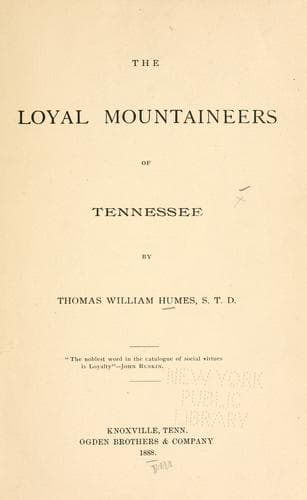
The loyal mountaineers of TennesseeHumes, Thomas William
Philosophy
The loyal mountaineers of Tennessee
Humes, Thomas William
Tennessee, East -- History -- Civil War, 1861-1865
The expedition of Gen. Burnside into East Tennessee had been
conceived in his mind at least six months before it was made. He
took command of the department of the Ohio, at Cincinnati, March
25, 1863. It included Indiana, Ohio, Michigan, Illinois, Kentucky
(excepting west of the Tennessee River), and “all of East Tennessee
that he might at any time occupy.” At that date Gen. Pegram, with a
formidable cavalry force, had marched from East Tennessee across the
Cumberland River, had driven the United States forces to the north
of Kentucky River, and had taken possession of Danville and its
vicinity. In a few days, by direction of Gen. Burnside, Gen. Gilmore
compelled Gen. Pegram to retreat; and afterwards at Somerset, with
the co-operation of Gen. Manson, commanding a part of Gen. Boyle’s
forces, completely defeated Pegram, and made the Cumberland River
again the dividing line. Central Kentucky was for the next month
free from hostile forces. Early in May, upon the organization of the
troops in that State into the Twenty-third army corps, under Gen. G.
L. Hartsuff, Gen. Burnside at once commenced to make preparations
for moving into East Tennessee. On June 3d he left Cincinnati to
take command in person of the troops which were organizing for that
movement, and which consisted of the two divisions of the Ninth army
corps under Gen. Wilcox and a portion of the Twenty-third corps
under Gen. Hartsuff. On arriving at Lexington, Ky., he received an
order to send the Ninth corps to Gen. Grant, and in consequence,
the expedition to East Tennessee had to be deferred. After Col.
Sanders returned to Kentucky from his raid, “preparations were still
continued” by the General, “in the hope of being able to spare
sufficient force to go into East Tennessee.” But they were disturbed
by the approach of the rebel General, John H. Morgan, with a large
cavalry force, about the 1st of July, on his memorable raid through
Kentucky and Indiana into Ohio, which resulted in his surrender near
Steubenville, and the capture altogether of 3,000 men--three-fourths
of the troops with which he had entered Kentucky. While the United
States soldiers were absent in pursuit of Morgan, a considerable
force of rebel cavalry under Col. John S. Scott, went from East
Tennessee, crossed the Kentucky River and approached the Ohio,
evidently with the view of assisting Morgan on his expected return.
They were soon driven out of Kentucky with heavy loss, by Col.
Sanders’ cavalry after it came back from the pursuit of Morgan.
Public-domain text, read in full here on John Shaqi.
Reviews
Reviews
No reviews yet
Be the first to share your thoughts on this work.
Elsewhere in the archive
Join the Discussion
Join the discussion
Sign in to leave a comment or review.
Sign InorCreate an account