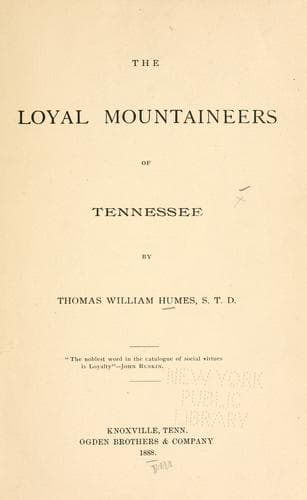
The loyal mountaineers of TennesseeHumes, Thomas William
Philosophy
The loyal mountaineers of Tennessee
Humes, Thomas William
Tennessee, East -- History -- Civil War, 1861-1865
he assured the eager troopers that the man they supposed to be a
Confederate soldier, was only a citizen at the house as a visitor.
They were at once pacified, made apologies and rode away.
The United States army had indeed arrived, and to look upon it, the
delighted Union man sought without delay the principal street. At the
end of two squares he found the way barred by a sentinel. In the halt
thus imposed upon all persons, he was entertained by the outspoken
displeasure of the company--chiefly ladies of the neighborhood--at
the incoming of the “Yankees.” One of them--a truly amiable, but
for the time deeply offended matron--gave free vent to her feelings
until the current of her thoughts was diverted at the suggestion of
a bystander, that the town might well be thankful for the protection
the United States army afforded it from robbers. Only a few nights
before they had stolen from her a valuable pony. This recollection
turned her resentment from “Lincoln and his hordes” to the source, as
she thought, of all present woes to the country. “If it had not been
for South Carolina,” she complained, “we should not have had all this
trouble!”
Gen. Burnside, on his arrival, established his headquarters in a
large mansion recently vacated by its owner, which stood near the
principal street and had a spacious front yard. From its covered
porch a large United States flag was lifted up, and in its drooping
folds the welcoming crowd wrapped themselves with beaming faces.
Expressions of joy from the people rung upon the air. They hailed the
General as their deliverer from a hated power and the oppression it
inflicted; and also as the representative of their beloved nation,
clothed with its authority and armed with its sword. Some of them
were so glad that they scarcely knew what to do with themselves. In
the overflow of their emotions they could have clasped him in their
arms, or, if opportunity had served, have drawn him in a carriage
with their own hands all over the town, that everybody, men, women
and children, might look upon him. Meanwhile he bore himself with
dignity and gentleness. Briefly he addressed them with words suited
to the occasion and full of friendly sympathy. Then, his attentive
hearers, elated with joy as with new wine, were eager for more
discourse. An adjournment was made to the court-house, and from its
front several citizens addressed the assembly in the open air.
Public-domain text, read in full here on John Shaqi.
Reviews
Reviews
No reviews yet
Be the first to share your thoughts on this work.
Elsewhere in the archive
Join the Discussion
Join the discussion
Sign in to leave a comment or review.
Sign InorCreate an account