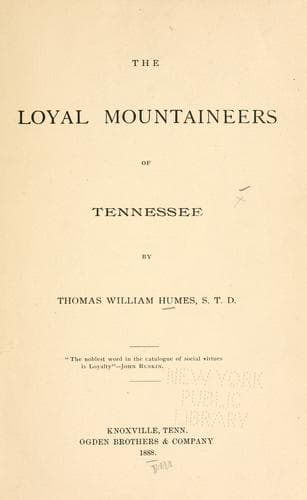
The loyal mountaineers of TennesseeHumes, Thomas William
Philosophy
The loyal mountaineers of Tennessee
Humes, Thomas William
Tennessee, East -- History -- Civil War, 1861-1865
General Burnside in his official report, says in connection with a
recital of his first encounter with Longstreet near Loudon: “Knowing
the purpose of Gen. Grant as I did, I decided that he could be
better served by drawing Longstreet farther away from Bragg than by
checking him at the river, and I accordingly decided to withdraw
my forces and retreat leisurely towards Knoxville, and soon after
daylight on the 15th the whole command was on the road.” His object
was attained. As he retired, his adversary pursued, except that
Longstreet sent Wheeler’s cavalry by way of Maryville to seize the
heights on the south side of the river, opposite and commanding
Knoxville. Wheeler surprised and captured at Maryville, the Eleventh
Kentucky. Gen. Parkes with a part of the 23rd corps, and a body of
cavalry under Gen. Sanders had been left at Knoxville to protect
it. Sanders checked the progress of Wheeler and fell back upon the
heights south of the river, where he and Parkes defeated Wheeler, who
retreated to join Longstreet by way of Louisville. To that village,
Longstreet had tried to have boats towed up the Tennessee River, but
the current was too rapid.
New life was given the United States troops at the front by
Burnside’s coming to them. As he went forward, he passed by a large
body of them, near Lenoir’s Station. “Under his slouched hat,” says
one of his observers, “there was a sterner look than there was wont
to be.” “There is trouble ahead,” said the men: but the cheers which
rose from regiment to regiment, as, with his staff and battle flag he
swept past, told the confidence which all felt in “old Burnie.” Their
strong trust in him was also shown when he arrived near Loudon and
took the chief command. One of them relates:
“Notwithstanding the continued rain and the heavy roads, the presence
of our commander produced a noticeable change in the spirit of the
troops. An hour before, the men were deliberately covering themselves
with mud, as if that were an appropriate mourning for their departed
hopes, and their guns seemed naturally to seek a reverse position.
But now they were all animation, and a slip here and a fall there,
was made the cause of laughing, notwithstanding the rain. I think the
secret of it was, that we reposed in our leader an almost perfect
confidence resulting from long and tried associations. Few corps
commanders have ever won the affection of their men as Burnside did.”
Public-domain text, read in full here on John Shaqi.
Reviews
Reviews
No reviews yet
Be the first to share your thoughts on this work.
Elsewhere in the archive
Join the Discussion
Join the discussion
Sign in to leave a comment or review.
Sign InorCreate an account