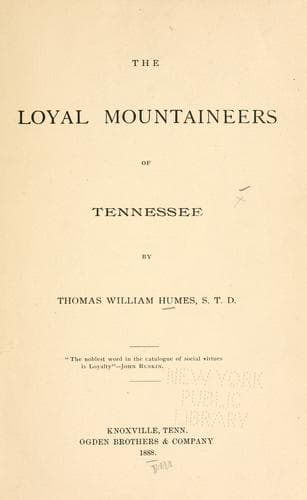
The loyal mountaineers of TennesseeHumes, Thomas William
Philosophy
The loyal mountaineers of Tennessee
Humes, Thomas William
Tennessee, East -- History -- Civil War, 1861-1865
The retreating march on the 15th was made with difficulty. Clouded
heavens in the morning, soon gave forth heavy rain, followed by a
cold north wind. The roads were almost impassable. Regiments of
infantry had often to pull the artillery with ropes from out of
the deep, stiff mud in which it stuck. Now and then, horses were
held fast by the tough, clay soil, until a detail of men came to
their deliverance. Soldiers lost their shoes in it, and on running
back to recover them were greeted by the merry laughter of their
companions. At Lenoir’s, the army halted for the night of Sunday. The
air was bitter cold. To avoid observation only one fire was allowed
to each company. The hours of darkness passed away in broken rest
and petty alarms. In the early morning, one hundred wagons, whose
mules were needed to draw the artillery, and also as much of the
supplies--bacon, coffee, sugar--as the soldiers could not carry,
were burned. Officers’ baggage, books--everything that could not
well be transported--were destroyed. The trains were started for
Knoxville, guarded by the 79th New York Highlanders. Then a number of
military divisions and the artillery, moved forward to the village of
Campbell’s Station, eight miles distant. A brigade guarded the rear,
and at one time was severely pressed by its enemies, until it turned
and drove them back. In the struggle. Col. Smith of the 20th Michigan
was killed at the head of his regiment after most able conduct.
Not far west of Campbell’s Station another highway from Kingston
forms a junction with the road they traveled. It was believed
that Longstreet would try to reach that point first, in order to
cut Burnside off from Knoxville. Therefore, the latter sent Gen.
Hartraupt with his division and Col. Biddle’s cavalry, in advance to
the fork of the roads. They were successful in anticipating their
foes, and held the point of junction until all the United States
troops and their trains had passed, but not without some fighting.
Among their losses by death, was one specially lamented, that of
Lieut. P. Marion Holmes, of Charlestown, Mass., a member of the
Bunker Hill Club, who bore on his person its badge, engraved with the
line,
“_Dulce et decorum est, pro patria mori_,”
quoted by Warren just before the battle of Bunker Hill. He is
described as “frank, courteous, manly, brave; one who had won all
hearts.”
Public-domain text, read in full here on John Shaqi.
Reviews
Reviews
No reviews yet
Be the first to share your thoughts on this work.
Elsewhere in the archive
Join the Discussion
Join the discussion
Sign in to leave a comment or review.
Sign InorCreate an account