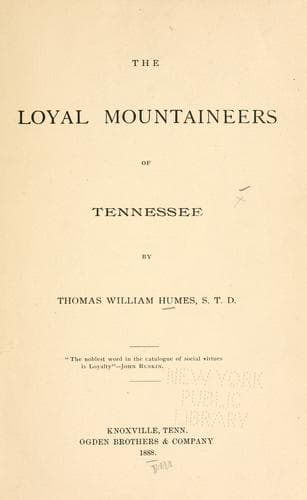
The loyal mountaineers of TennesseeHumes, Thomas William
Philosophy
The loyal mountaineers of Tennessee
Humes, Thomas William
Tennessee, East -- History -- Civil War, 1861-1865
Longstreet then maneuvred to turn the Federal left. As there was
some high ground on that hand, commanding Burnside’s position, which
he saw his enemy was endeavoring to occupy, and he could not, for
lack of men, extend his own line to prevent the threatened movement,
he moved his troops and established a new line upon a ridge nearly
three-fourths of a mile to the rear. This was done under a heavy
artillery fire from his enemy, but with no disorder. It was about
4 P. M. Quickly a fierce attack was made upon the new line, not in
front, but flank and rear, at the extreme left. That was handsomely
repulsed. His enemy went back in disorder, and did not renew the
fight. The United States troops were much elated by their success
against odds, Burnside having had only about five thousand men in
the battle, and his adversary from two to three times that number.
He states in his official report: “Our loss in killed, wounded and
missing was about three hundred, and that of the enemy must have
been very severe, as he was the attacking force.”[36] The “Rebellion
Record” extols the military maneuvres of both armies for skill and
beauty--as showing admirable discipline. Although comparatively an
insignificant fight, “it certainly will rank among those contests in
which real generalship was displayed. Every motion, every evolution,
was made with the precision and regularity of the precision on a
chess-board.” The result was decisive. Burnside’s line of retreat was
saved, and he was given the few precious hours that were absolutely
necessary to further fortify, and so, to hold Knoxville.
To that town, fifteen miles distant from Campbell’s Station, the
United States troops moved off silently, as soon as night fell.
During the night before at Lenoir’s, following upon a day of
weariness and anxiety, neither officers nor men had slept. No one
could speak to his fellow, and in the thick darkness through the
long, long night, they lay on their arms waiting for the morning,
which ushered in a day of hard fighting. When that was ended, their
soldierly patience and power of physical endurance were subjected to
the additional test of marching over very muddy roads for another
dark night. Some of them fell asleep from utter weariness as they
walked, but without losing their places in the ranks. About four
o’clock on the morning of Monday, November 17th, they reached
their destination. In the night, General Burnside arrived at his
headquarters.
Public-domain text, read in full here on John Shaqi.
Reviews
Reviews
No reviews yet
Be the first to share your thoughts on this work.
Elsewhere in the archive
Join the Discussion
Join the discussion
Sign in to leave a comment or review.
Sign InorCreate an account