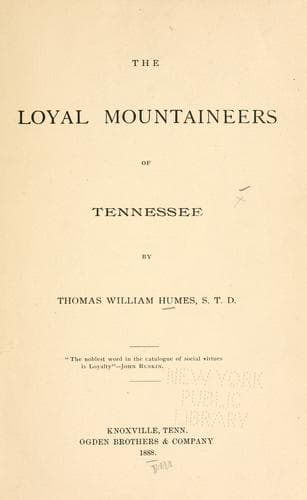
The loyal mountaineers of TennesseeHumes, Thomas William
Philosophy
The loyal mountaineers of Tennessee
Humes, Thomas William
Tennessee, East -- History -- Civil War, 1861-1865
In the afternoon of the preceding Saturday startling rumors were
circulated in Knoxville, that a considerable body of Confederate
cavalry had appeared on the south side of the river opposite the
town, and had attacked Col. Woolford with success, capturing a
portion of his regiment. It was said, “they are rapidly moving upon
the town,” “they are already at Rockford, only nine or ten miles away
and still coming.” At the same time Gen. Shackelford could be seen
with his staff upon Gay Street, riding towards the pontoon bridge,
which had been transferred from the Tennessee river at Loudon, and
thrown across it at Knoxville. Placed by Gen. Burnside in command
of all the cavalry, the reason of his then taking the field was the
arrival of Gen. Wheeler, sent by Gen. Longstreet from Loudon to take
possession of the heights on the south side of the river opposite
Knoxville. Considering the importance and peril of Gen. Shackelford’s
errand, he appeared to a citizen observer, cool and calm to the point
of indifference. Readers of romantic fiction and lovers of American
chivalry, are accustomed to associate with their ideas of the warrior
and hero a gay, prancing steed, of fiery temper and proud head. The
horse he rode was a gentle, well-conditioned pacer, with a short
tail, and the _tout ensemble_ of such a quadruped, capable of
serving equally well any and every member of a family. The chief of
cavalry himself, as he rode along the street, was composedly smoking
one of the short-stemmed pipes which were extensively used by the
soldiers. As the conflict on the south side ended in possession of
its hills being retained by the Federal troops, the unpleasant fears
Union citizens felt concerning the capture of the town were shortly
dispelled: but with the morrow similar apprehensions were aroused
among a few leading public men upon being informed of Longstreet’s
advance with his main army and of Burnside’s retreat upon Knoxville.
[Illustration: MAJ. GEN. S. P. CARTER.]
General Saml. P. Carter was of course advised of those movements
and was strongly impressed, as well he may have been, with the
imminent danger there was, that the United States army with only
12,000 men, would be unable to hold the town against 20,000 men
including cavalry. In his regard for the safety of certain prominent
Union citizens, he sent them word of the disastrous contingency
shortly ahead, and, if they chose to escape the consequences of its
occurrence, that he would provide them an escort as far as expedient
on their way to the more favored clime of Kentucky. At such a time,
men whose active locomotion may deliver them from imprisonment that
might end in death, are apt to
“Stand not upon the order of their going,
But go at once.”
Public-domain text, read in full here on John Shaqi.
Reviews
Reviews
No reviews yet
Be the first to share your thoughts on this work.
Elsewhere in the archive
Join the Discussion
Join the discussion
Sign in to leave a comment or review.
Sign InorCreate an account