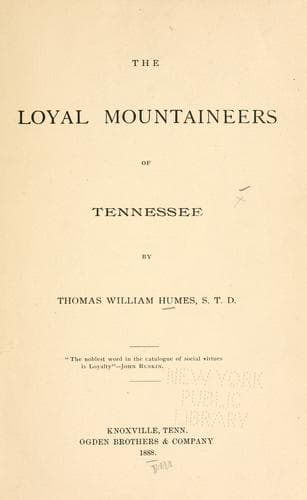
The loyal mountaineers of TennesseeHumes, Thomas William
Philosophy
The loyal mountaineers of Tennessee
Humes, Thomas William
Tennessee, East -- History -- Civil War, 1861-1865
Their dislike to travel night and day by wretched roads, over
mountains and unbridged rivers, and their sensitiveness to ridicule
for imputed cowardice, are not strong enough to overcome their love
of personal liberty and life. Many or all of them who received the
Provost Marshal General’s message--some of whom were of less note but
still liable to violent treatment if they were captured--speedily
took their leave of home and its comforts and were conducted by Capt.
A. J. Ricks, eight miles to the picket lines. Among the refugees were
John Baxter, William G. Brownlow, Samuel R. Rodgers, Thos. A. R.
Nelson, O. P. Temple, John M. Fleming, Samuel Morrow and M. M. Miller
of Knoxville, and John Netherland and Absalom A. Kyle of Rogersville.
It was after nightfall and raining heavily when they started, and
their transit on horseback through the darkness upon a road shortly
before traveled and reduced to mire by 6,000 or 7,000 hogs that
had been brought in to supply the army, could not fail to attract
attention from people of the country through which they passed.[37]
Despite all perils and difficulties the journey was at length safely
accomplished.
The company thus delivered from impending harm, might have been
joined at the start by some other citizens of less prominence, had
they been included in the message and given an opportunity to depart.
One of that description had been informed in succession by his
personal friends of both parties, that it was intended, if the town
fell into the hands of Longstreet, to seize and hold him as hostage
for a contumacious enemy of the United States whom Gen. Burnside had
found it necessary to send to Camp Chase. He gave no heed to the
warning, because he rested in his strong impression of the town’s
security from enemies, but this mental persuasion was disturbed on
the afternoon preceding the exodus of noted public men, as just
related. Passing along the street in utter ignorance of events then
transpiring between the hostile armies not far from Loudon, he met
a fellow-citizen of capricious loyalty, who had been known as a
“Southern man” during the Confederate _regime_, but was understood
to have publicly thanked the Lord upon the advent of Gen. Burnside’s
army, for “bringing in our friends.” In the conversation that ensued
on the street, the person of versatile opinions indulged in such
fault-finding with the United States Government, its policy, &c., as
to suggest a strong suspicion that he was adapting his sails to a
contrary wind. Acting upon this conjecture, the citizen who had been
forewarned of his danger if the town should change its masters, went
immediately to the house of Gen. Carter, and found his staff in a
state of unusual excitement. In reply to his question, “What is the
matter?” the visitor was told, “Longstreet is marching upon Knoxville
with, it is said, 20,000 men. Burnside is retreating from Loudon,
fighting as he comes. We do not know what is going to happen.” Said
Public-domain text, read in full here on John Shaqi.
Reviews
Reviews
No reviews yet
Be the first to share your thoughts on this work.
Elsewhere in the archive
Join the Discussion
Join the discussion
Sign in to leave a comment or review.
Sign InorCreate an account