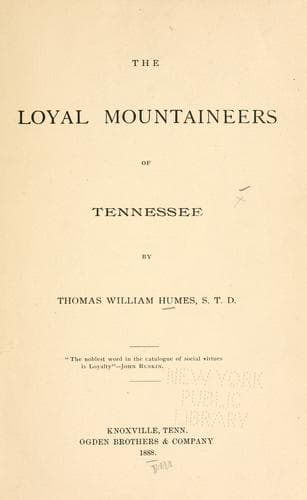
The loyal mountaineers of TennesseeHumes, Thomas William
Philosophy
The loyal mountaineers of Tennessee
Humes, Thomas William
Tennessee, East -- History -- Civil War, 1861-1865
From Campbell’s Station, Gen. Burnside, on November 16th, sent
instructions to Capt. Orlando M. Poe, chief engineer of the
Department of the Ohio, who was at Knoxville, to select lines
of defence for the town, in readiness for the troops to occupy
positions. This order Poe was able, from previous and frequent
examinations of the ground and his familiar knowledge of the army, to
fulfil quickly. Before leaving Kentucky he had organized an engineer
battalion from the 23d corps and by great efforts had brought over
the mountains engineering tools.
Knoxville is situated chiefly on a hill, about two hundred feet high
on the north bank of the Tennessee river. The hill, at its top, has
a wide table land, and is separated on the east and west by creeks
from even higher hills that rise up from the river. In the valley
immediately on the north, runs the road of the East Tennessee,
Virginia and Georgia Railway Company, beyond which the town was then
but partially extended.[38]
Capt. Sims’, 24th Indiana, and Henshaw’s battery (the first of
six and the second of two James’ rifle guns), and also four brass
six-pounders, occupied Temperance Hill on the east side of First
Creek, supported by Chapin’s Brigade of White’s Division, and Riley’s
Brigade of Hascall’s Division of the Twenty-third army corps.
Shield’s battery, six twelve-pound Napoleons, and part of Wilder’s,
occupied Mabry Hill, which is higher and farther east than Temperance
Hill. These were supported by the brigades of Cols. Hoskins and
Casement, extending from Bell’s house on the northern base of Mabry
Hill to the river south of it. One section of twelve-pound howitzers
was planted on Flint Hill, nigh to that point on the river manned by
soldiers of loyal Tennessee regiments. On the west of the main town
and Second Creek, Roemer’s battery of four three-inch rifle guns,
occupied College Hill near the river, supported by Morrison’s brigade
of the First Division, Ninth army corps. At the fort on the hill-top
northwest of College Hill, were placed Benjamin’s battery of four
twenty-pound Parrotts, and Buckley’s battery of six thirteen-pound
Napoleons, supported by Humphrey’s and Christ’s brigades, of the
First Division, Ninth army corps. The ground occupied by this
Division extended from the river near the mouth of Second Creek
around to the point where the East Tennessee, Virginia and Georgia
Railway crosses Second Creek, northwest of the older town, and was
under the command of Gen. Ferrero. Gitting’s battery was on Vine
street, overlooking the railroad depot on the north, and between it
and First Creek was the Fifteenth Indiana battery of three three-inch
rifle guns--these two batteries being supported by the Second
Division, Ninth army corps, (Gen. Hartraupt’s), extending from Second
to First Creek and parallel to the railroad.
Public-domain text, read in full here on John Shaqi.
Reviews
Reviews
No reviews yet
Be the first to share your thoughts on this work.
Elsewhere in the archive
Join the Discussion
Join the discussion
Sign in to leave a comment or review.
Sign InorCreate an account