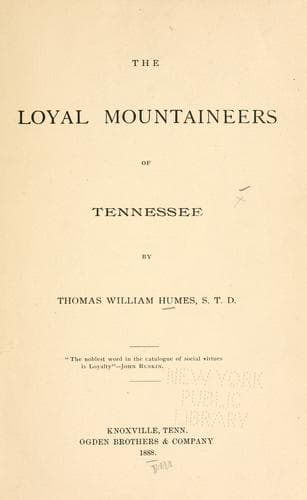
The loyal mountaineers of TennesseeHumes, Thomas William
Philosophy
The loyal mountaineers of Tennessee
Humes, Thomas William
Tennessee, East -- History -- Civil War, 1861-1865
On the south side of the river were Shackelford’s cavalry and
Cameron’s brigade of Hascall’s Division, Twenty-third army corps, the
latter supporting Koukle’s battery of four guns and two sections of
Wilder’s battery (all three-inch rifles). Riley’s brigade was held in
reserve in the streets of the town.
The defences at first raised by the troops were simply ditches four
feet wide and deep, with the excavated earth embanked on the outside;
except the more formidable structures on Temperance Hill and those
held by Lieut. Benjamin’s battery built by the engineer battalion.
Fatigued as were the soldiers who had been at Campbell’s Station,
they as well as others, labored with energy upon the entrenchments
throughout the whole day and night of November 17th, and would then
have been compelled to cease, had not Col. Sanders, with his cavalry
on the Kingston road, and Col. Pennybaker, with his mounted regiments
on the Clinton road, held Longstreet’s forces in check. Capt. Poe
says: “The hours in which to work, that the gallant conduct of our
cavalry secured us, were worth to us a thousand men each.” The next
morning two hours of rest were given them, and were used in sleep by
the men without delay on the ground where they stood. At the same
time Gen. Burnside, in consultation with Capt. Poe and Col. Sanders,
was informed by the first that the rifle pits would be ready for
defence before the end of many hours, and by the other, that with his
cavalry, “seven hundred strong and in good fighting trim,” he could
hold Longstreet at bay until that time had expired. For another day
and night the men persevered in labor with ready wills and hands. The
suggestion by one of their officers that the alternative of effective
resistance to the enemy would be a visit to Libby prison, served as
an incentive to both industry and heroism. Many of them had been
without rest but for two hours in a hundred, and it was necessary
for their relief that contrabands and citizens should be pressed
into service. The former did heartily the tasks assigned them, the
difficulty of which in some instances may be inferred from the fact
that places for the guns of Benjamin’s and Buckley’s batteries could
only be cleared by four hours diligent labor of two hundred men. Of
the citizens who had to work on the entrenchments, they who were
loyal to the United States did their duty cheerfully, but “many,”
according the Chief Engineer, “were rebels, and worked with a very
poor grace, which blistered hands did not tend to improve.”
Public-domain text, read in full here on John Shaqi.
Reviews
Reviews
No reviews yet
Be the first to share your thoughts on this work.
Elsewhere in the archive
Join the Discussion
Join the discussion
Sign in to leave a comment or review.
Sign InorCreate an account