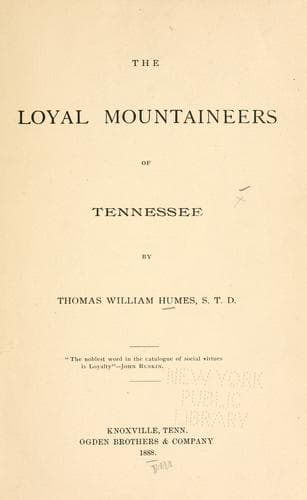
The loyal mountaineers of TennesseeHumes, Thomas William
Philosophy
The loyal mountaineers of Tennessee
Humes, Thomas William
Tennessee, East -- History -- Civil War, 1861-1865
In the afternoon of the 18th the skirmishing between Sanders’
dismounted cavalry and Longstreet’s advance, two miles west of the
town, was concluded by a fire of artillery upon Sanders, which
compelled him to retreat after he had successfully resisted--with
rail fences as shields--the charges of his powerful foe. At the close
of the contest he received a mortal wound, reeled upon his horse and
falling, was caught in the arms of his men and taken to a house in
town. In full possession of his mind, there was no disturbance of
its calmness by the answer of the surgeon to his question as to the
nature of his wound. Death had no terrors for him. “He had done his
duty and served his country as well as he could.” That was all in few
and simple words he had to say. The following day, being informed
that the end of his life was nigh at hand, he asked for a Christian
minister, and then that he should be baptized in the faith and name
of Jesus, the Son of God. The Rev. Mr. Hyder, chaplain of the post,
complied with this earnest desire, and a writer in the _Atlantic
Monthly_[39] relates that, “then the minister in prayer commended
the believing soul to God, General Burnside and his staff, who were
present, kneeling around the bed. When the prayer was ended, General
Sanders took General Burnside by the hand. Tears dropped down the
bronzed cheeks of the chief as he listened to the last words which
followed. The sacrament of the Lord’s Supper was now about to be
administered, but suddenly the strength of the dying soldier failed,
and like a child he gently fell asleep.” To this pathetic recital its
author appends the quotation from the sayings of Him who spake as
never man spake: “Greater love hath no man than this, that a man lay
down his life for his friends.”
It was found impossible to assemble the chief officers of the
United States army by day at the funeral of their slain companion.
Longstreet’s troops had advanced to the ridge for which they fought
and planted themselves within rifle range of the defences on the
northwest, and the town had become fairly besieged, north, from the
river above to the river below. Lines parallel with and in cannon
range of Burnside’s, had been established, and redoubts had been
thrown up for batteries, which on the third day opened a continuous
fire that met with prompt answer. There was need of constant
vigilance and alertness upon the long line of defences, and those in
command could not prudently leave their posts of duty in daylight.
Public-domain text, read in full here on John Shaqi.
Reviews
Reviews
No reviews yet
Be the first to share your thoughts on this work.
Elsewhere in the archive
Join the Discussion
Join the discussion
Sign in to leave a comment or review.
Sign InorCreate an account