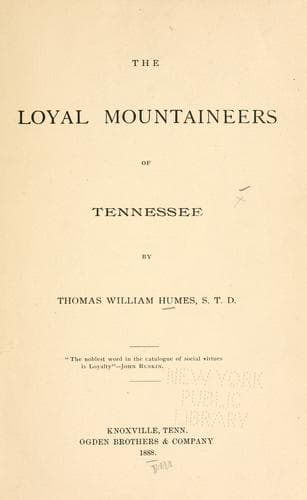
The loyal mountaineers of TennesseeHumes, Thomas William
Philosophy
The loyal mountaineers of Tennessee
Humes, Thomas William
Tennessee, East -- History -- Civil War, 1861-1865
“Hark! to the call of the bugle horn,
Or the quick rattle of mustering drum!
Swift to the summons at even or morn,
Bronzed and bearded the gallants come.
Balls from the rifle-pits _plug_ about,
Great guns boom from the big redoubt,
And the angry hiss of the burning shell
Screams through the fire of smoke and hell.
‘Who’s for the trenches? We must have it out;
Now is the time, lads, to try the redoubt.’
Belted with fire and shrouded with smoke,
Girdled with rifle-balls as with a wall,
Yet with a yell from the trenches they broke,
Plunging through rifle-balls, hell-fire and all.”
REV. WALTER C. SMITH,
_In “Hilda Among the Broken Gods.”_
To a peace-loving civilian, not enlisted in the fray, it seemed
on the 28th of November, that there had been enough of wounds and
blood-shed during the siege to have satisfied any but a very ruthless
soldier. Such were not those who engaged in strife at Knoxville, but
war has its inexorable demands, and the soldier cannot refuse them.
Therefore must sanguinary scenes be enacted on the morrow at Fort
Sanders, at the sight of which the cheek of such a civilian might
well grow pale with horror. All that happened on the preceding ten
days would not compare with it. It was shocking to hear, at the first
of the investment, the noise of musketry and artillery, knowing that
it came from fellow-countrymen engaged in killing each other, and
shocking to listen to the groans of wounded soldiers, borne along
the streets in ambulances from the field of battle, and one’s pity
was deeply moved at seeing strong men prostrate in hospitals, with
features sharpened by pain or pallid with the touch of death, but if
one would learn greatly more of the evils of war, let him wait for
the morrow and study the lesson it teaches.
At one time during the siege the hospitals in use became over-crowded
and others had to be provided. One afternoon a Union citizen who
was thought to have considerable influence with the United States
military authorities, was visited by Judge A., who said:
“Mr. B., they are about to take the house of the Rev. Mr. C. and use
it as a hospital.”
“I am very sorry to hear it,” replied B.
The Rev. Mr. C. had a wife and children, and might well be
commiserated, if he and they should be turned out of doors in such
sharply cold weather.
“I wish,” proceeded the Judge, “you would see Gen. Burnside, and if
possible, prevent it.”
“Certainly,” said B.; “will you not go with me?”
The Judge consented and they started for headquarters, but upon
reaching the first street corner, the Judge stopped.
“Mr. B.,” said he, “I have not much influence with the authorities. I
wish you would undertake this matter alone.”
Public-domain text, read in full here on John Shaqi.
Reviews
Reviews
No reviews yet
Be the first to share your thoughts on this work.
Elsewhere in the archive
Join the Discussion
Join the discussion
Sign in to leave a comment or review.
Sign InorCreate an account