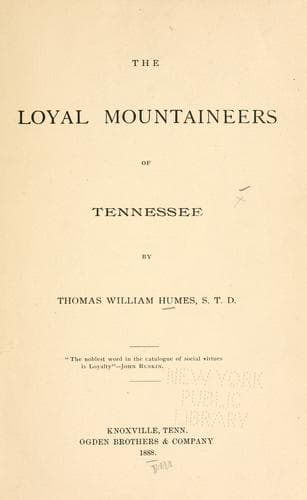
The loyal mountaineers of TennesseeHumes, Thomas William
Philosophy
The loyal mountaineers of Tennessee
Humes, Thomas William
Tennessee, East -- History -- Civil War, 1861-1865
The 26th was thanksgiving day, and Gen Burnside issued an order for
its observance, not in customary feasting, which was impossible, but
by gratitude to God; and he recalled to his men’s minds the trials
of those who established the Republic, as an encouragement to endure
their own hardships. And indeed they had need of fortitude, for not
only were they hungry, but the weather was cold--the overcoats and
blankets of many had been cast away at Campbell’s Station, with
their tents--and their resource for warmth was to crawl, when off
duty, into holes which they dug in the bank, back of the trenches.
Still as they ate their bits of bread, their thoughts were turned to
loved ones at home, and their hearts might be thankful. After dark,
important positions were made stronger in front with telegraph wires
stretched from stump to stump.
On the 27th Longstreet kept up active firing chiefly with artillery,
but Burnside’s army was silent. Early that evening there was much
cheering by the besiegers and music from their bands. In the night
men were employed in chopping down trees, clearing the way for a
battery on the south side river bluff, two thousand yards and more
from Fort Sanders. The signs of their taking positions in the front
for attack were so strong in the afternoon that the Federal soldiers
stood in the trenches awaiting it.
Both armies were hard at work on Saturday, the 28th. The battery of
six guns on the river bluff opened fire upon Roemer’s battery between
Fort Sanders and west of College Hill, but did no harm. About 11
o’clock at night, which was cloudy and very dark, the enemy attacked
and drove in the pickets in front of Fort Sanders, captured many of
them and occupied their lines about one hundred yards away from the
Fort. The fighting was hot, and lasted two hours. Capt. Buffum, with
a fresh detail, established a new line of pickets and by hard work,
new pits were thrown up before day. There was skirmishing all night
long, and a slow cannonading from the enemy’s guns, principally upon
Fort Sanders. The hours of darkness seemed long to Burnside’s men,
for they had to stand in the trenches, with no extra clothing to
protect them from the cold.
Evidently, Fort Sanders was to be assaulted. Longstreet had had
his arms around Knoxville for ten days, and had closed its doors
to all messages from Burnside’s friends. Grant had sought to send
encouraging words from Chattanooga to the besieged commander, but
could only dispatch them to Gen. Wilcox at Cumberland Gap, in the
hope that by some means or other they might be transmitted to
Knoxville. And now, the Confederate commander determined to come into
close wrestle with his adversary and bring the siege to a triumphant
conclusion.
CHAPTER XVI.
HOSPITAL NEEDS--A SCENE AT HEADQUARTERS--INCREASED
DESTITUTION--ASSAULT ON FORT SANDERS--LONGSTREET
RETREATS--SHERMAN’S APPROACH--BURNSIDE GIVES HONOR TO HIS ARMY.
Public-domain text, read in full here on John Shaqi.
Reviews
Reviews
No reviews yet
Be the first to share your thoughts on this work.
Elsewhere in the archive
Join the Discussion
Join the discussion
Sign in to leave a comment or review.
Sign InorCreate an account