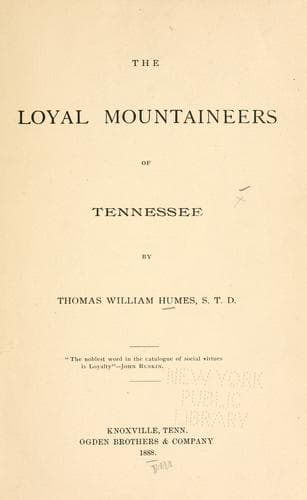
The loyal mountaineers of TennesseeHumes, Thomas William
Philosophy
The loyal mountaineers of Tennessee
Humes, Thomas William
Tennessee, East -- History -- Civil War, 1861-1865
After that date, the sentiment of aversion to slavery survived and
in various ways was manifested, and although it was eventually
counteracted by the political strife which grew out of the subject,
it never ceased to exist firmly in many minds. A home in the great
valley of East Tennessee was not formerly adapted to the cultivation
of pro-slavery sympathies in persons of humane disposition and
healthy sensibilities. For along the highway through that valley,
slave-dealers transported negroes whom they had bought in Virginia
and intended to sell in Southwestern States. The sales of these
unfortunates, often because of their masters’ necessities, had
in some instances separated families: and lest the men, moved by
sorrow over the disruption, by aversion to their destined market,
or by desire for freedom, should escape on the way, the dealers
fettered them two and two to a strong chain running lengthwise
between. It was pathetic to see them march, thus bound, through the
towns, and to hear their melodious voices in plaintive singing as
they went. By-standers then saw slavery without the disguise, with
which Laurence Sterne pronounced it “still a bitter draught,” and
the spectacle was apt to create or strengthen antipathy to the
institution in unbiased minds.
Knoxville, the central town of this entire region, stands on the
northern bank of the Tennessee River, four miles below the junction
of the Holston and French Broad rivers, which rise, the first in
Virginia and the second in North Carolina. From 1792 to 1796 it was
the capital of the “Territory south of the river Ohio,” and from 1796
to 1816, that of the State of Tennessee. Its society had at that
time a relative distinction for character and influence which it has
never lost In 1865 the town received a strong impulse to growth, from
which its population in 1870 was 8,682, in 1880 it was 9,693, and
in 1886 it was about 30,000. The great, and of late, rapid increase
is largely owing to immigration from Northern States. Thrifty and
enterprising new-comers have added in a marked degree to the trade
and prosperity of the place. Like results have followed more or less
throughout East Tennessee, especially at Chattanooga, since the war
disclosed the natural advantages of the whole region to the knowledge
of the world outside of it. So obvious are the benefits that will
accrue to it from worthy immigrants, that even the most zealous
sectionalists have yielded their prejudices so far as to give even
“Yankees” not only a welcome, but an invitation to dwell in the land.
[Illustration: LLOYD P. SMITH.]
Public-domain text, read in full here on John Shaqi.
Reviews
Reviews
No reviews yet
Be the first to share your thoughts on this work.
Join the Discussion
Join the discussion
Sign in to leave a comment or review.
Sign InorCreate an account