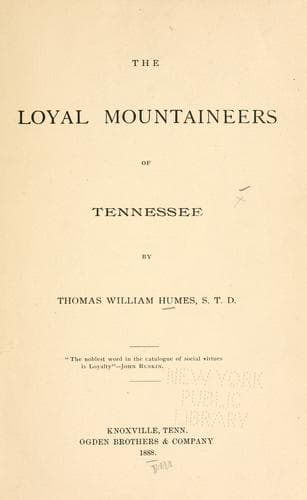
The loyal mountaineers of TennesseeHumes, Thomas William
Philosophy
The loyal mountaineers of Tennessee
Humes, Thomas William
Tennessee, East -- History -- Civil War, 1861-1865
On December 3rd, the enemy’s trains were seen moving eastward, and
at night Capt. Audenried, of Gen. Sherman’s staff, reached Gen.
Burnside’s headquarters. Relief was actually on the way, and the
movements of Longstreet’s trains on the 4th indicated an early
abandonment of the siege. In the afternoon, however, his skirmishers
were unusually active and their fire was easily provoked. The
besieged stood under arms all night in expectation of an attack, but
the zealous shooting which had led them to fear it, was intended to
cover another sort of movement. The next morning a profound silence
reigned all around the town outside its defences. The pickets of the
36th Massachusetts, under Capt. Ames, were the first to discover
that the besiegers had taken up the line of march. The First brigade
began to cheer over the discovery, and this cheering was echoed all
along the lines until the men almost lost their breath. Their hats
were thrown away as they shouted, and when every man’s head was
re-covered he shook hands with every other man he met, and there was
a general jubilee. Longstreet had moved off, as Burnside said, “in
remarkably good order,” and the few cavalry who could be mounted for
pursuit were unable to make any impression on him.
On that day a letter came to headquarters with congratulations from
Gen. Sherman, at Maryville, 17 miles distant, saying that he could
bring 30,000 men into Knoxville the next day, but as Longstreet had
retreated, unless Burnside specified that he wanted troops, Sherman
would let his men rest and he himself would ride to see him. On the
morrow, the distinguished visitor arrived in town and was hospitably
entertained by the Commander-in-chief.[48] Their conference resulted
in the agreement that Sherman’s forces, with the exception of Gen.
Granger’s corps, should return to Grant at Chattanooga.
On Monday, December 7th, all available infantry were sent in pursuit
of Longstreet and halted at Rutledge. The cavalry went to Bean’s
Station but refrained from attacking him at Red Bridge, for want of
sufficient strength. On the 11th, Gen. Burnside, in compliance with
his previous suggestion, was relieved by Maj. Gen. Foster in command
of the Department, and the following day he departed for Cincinnati.
There, a few days afterwards, in a public speech, he gave all the
honors he received, to his officers and soldiers. One of them has
said: “These kindly words” they “will ever cherish; and in all their
added years, as they recall the widely separated battle-fields, made
forever sacred by the blood of their fallen comrades, and forever
glorious by the victories there won, it will be their pride to say,
‘We fought with Burnside at Campbell’s Station and in the trenches at
Knoxville.’”[49]
Public-domain text, read in full here on John Shaqi.
Reviews
Reviews
No reviews yet
Be the first to share your thoughts on this work.
Elsewhere in the archive
Join the Discussion
Join the discussion
Sign in to leave a comment or review.
Sign InorCreate an account