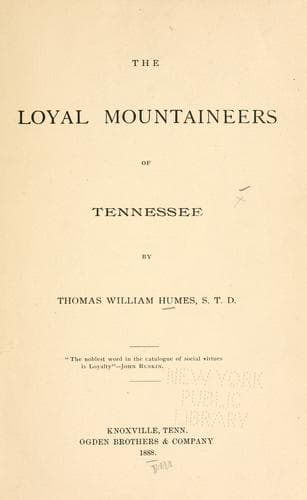
The loyal mountaineers of TennesseeHumes, Thomas William
Philosophy
The loyal mountaineers of Tennessee
Humes, Thomas William
Tennessee, East -- History -- Civil War, 1861-1865
Burnside’s departure from East Tennessee was witnessed generally
with sincere and in some instances profound regret. He had the
affectionate esteem of the people--which to every wise and good man,
is of more value than admiration of his talents. His conduct of
military affairs had been grandly heroic, and he was justly rejoiced
over the behavior of his men. He wrote:
“I shall ever remember with gratitude and pleasure, the co-operation,
devotion, courage and patient endurance of the brave officers and men
of the Ninth and Twenty-third corps, who have served so faithfully
and conspicuously in Kentucky and East Tennessee. During the whole
siege, and in the midst of the most arduous labor and greatest
privations I never heard a word of discontent or distrust from any
one of them. Each man seemed anxious to do his whole duty, and to
their perseverance and courage is due the ultimate success of the
defence of Knoxville.
“The loyal people of East Tennessee will always be gratefully
remembered by me for their hearty co-operation, efficient aid and
liberal hospitality.”
Chief Engineer, Captain Poe, has said:
“There is no language sufficiently strong which I can use to express
my admiration for the conduct of the troops. From the beginning of
the siege to the end, every man did his whole duty. The cheerful
looks and confident bearing which met us at every turn, made it seem
as though we were sure of victory from the first. It is doubtful
whether any man within our lines had at any time after the first
forty-eight hours, any fear of the result. All privations were borne,
all hardships undergone, with a spirit which indicated as plainly as
if written on the walls, that success would attend our efforts. The
troops of the Ninth and Twenty-third army corps were chivalric rivals
where duty was to be done. Never before had an engineer officer
less cause to complain of the manner in which his instructions and
directions were carried out.”
In the same connection, he testified to the great value of the
contrabands’ services, in many cases voluntarily offered. “Nearly two
hundred of them labored during the siege, and for the first week,
regularly eighteen hours in the twenty-four. The amount of their
work, performed both day and night, the whole time,” he said, “was
truly astonishing.”
CHAPTER XVII.
CAPTAIN POE’S CONCLUSIONS--PRESIDENT LINCOLN’S
PROCLAMATION--GENERALS SHERMAN AND GRANT--INTERCESSIONS WITH GEN.
FOSTER--BATTLE OF RESACA--INFLUX OF REFUGEES TO KNOXVILLE.
“What is the end of fame? ’Tis but to fill
A certain portion of uncertain paper.”
BYRON.
Public-domain text, read in full here on John Shaqi.
Reviews
Reviews
No reviews yet
Be the first to share your thoughts on this work.
Elsewhere in the archive
Join the Discussion
Join the discussion
Sign in to leave a comment or review.
Sign InorCreate an account