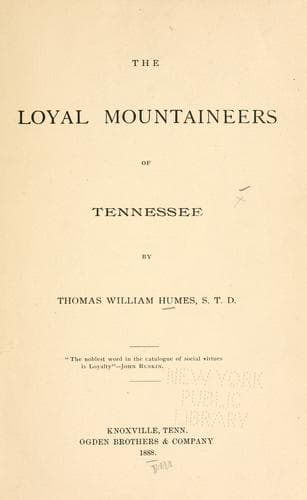
The loyal mountaineers of TennesseeHumes, Thomas William
Philosophy
The loyal mountaineers of Tennessee
Humes, Thomas William
Tennessee, East -- History -- Civil War, 1861-1865
The citizen, at his own request, was then shown to the room of
another United States Officer in the same house. There another
visitor, General ----, had preceded him. He was evidently under the
influence of potations from a bottle of strong drink that stood on
the table near him, and soon the new comer’s refusal to partake of
his spirituous devotions was resented by him with maudlin freedom and
profanity. By and by came a knock at the door, and who should enter
but the veritable General, who just before had been announced as too
ill to receive a visitor.
Not long before, Gen. Foster had sent copies of a Proclamation by
President Lincoln, to be distributed among the soldiers of Gen.
Longstreet. The latter thereupon had forwarded a sharp letter to
Foster, rebuking him for discourtesy, and inviting him to transmit
such documents directly to the commander, instead of seeking to
circulate them privily among the soldiers of his command. To that
letter Gen. Foster had prepared an answer, and he proceeded to read
it to the owner of the room, not probably without expectation of the
high encomium which that gentleman gave it.
When a suitable opportunity occurred, the citizen sought to fulfill
his mission, first by repeating to Gen. Foster the statement of the
committee of Free Masons, and conveying their petition for a short
reprieve to the young Kentuckian.
“No!” was the General’s reply, with knit brows and emphatic
tone, “he must die.” And die he did the next day, on the gallows.
Afterwards it was said that the execution might not or would not have
taken place, had not Longstreet’s army, early in its retreat, hung
a Union man, and left on a tree by the wayside his lifeless body,
placarded with offensive words. Information of the young Kentuckian’s
death, and of the Christian faith and hope with which he met it, was
sent to Richmond, Ky., by a clergyman who was with him in his last
days.[52] Although it was conveyed to his aged father and mother by
their friend,[53] with all possible discretion, the sorrowful news
almost broke their hearts. “But,” the ruthless politician may ask,
“must not war as well as law, have both its just and unjust verdicts?
Must it not have its revenges as well as its wrath?” If so, then let
it stop altogether its destroying marches and strife, and cease from
breaking hundreds and thousands of good old loving hearts by the
untimely death of their sons? Why not?
Concerning the second subject of intercession with Gen. Foster, the
imprisonment of Majors Moody and Smith, he was so far lenient as to
consent that they should not go to the common prison, but be confined
in comfortable quarters. Meanwhile, however, Provost Marshal General
S. P. Carter, in consideration of their physical condition, placed
them again on parole.
Public-domain text, read in full here on John Shaqi.
Reviews
Reviews
No reviews yet
Be the first to share your thoughts on this work.
Elsewhere in the archive
Join the Discussion
Join the discussion
Sign in to leave a comment or review.
Sign InorCreate an account