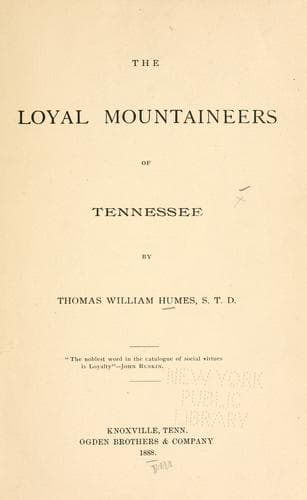
The loyal mountaineers of TennesseeHumes, Thomas William
Philosophy
The loyal mountaineers of Tennessee
Humes, Thomas William
Tennessee, East -- History -- Civil War, 1861-1865
Gen. Foster had received a wound during the Mexican war, from the
effects of which he still now and then suffered, and which furnished
a convenient reason for his being refused to unwelcome visitors. Upon
one very cold afternoon, two visits in quick succession were made to
a citizen, by persons who sought his mediation with General Foster.
First came a committee of Free Masons. A Kentuckian, who belonged
to a Texas regiment, had been unavoidably separated from it at the
time of Longstreet’s retreat from Knoxville, and he had endeavored to
rejoin it through the country south of the Tennessee river. In doing
this, he had unfortunately for himself, worn, in part at least, the
uniform of a Federal soldier, and had also entered in his diary that
he had represented himself as one, in conversation with a woman. He
was captured while hiding in a hay stack, was brought to Knoxville,
tried by court-martial and condemned to death as a spy. Strong
sympathy was felt for him by resident friends of the Confederacy,
and this was shared by the Free Masons, of which fraternity he was a
member. A committee of that order desired the citizen they visited
to intercede with Gen. Foster to reprieve the prisoner until further
proof of his innocence, which they believed to exist, could be
produced.
They had scarcely gone, when a regimental officer from Mississippi
made his appearance. Longstreet, in going eastward, had left in a
hospital at the paper mill three miles northwest of the town, a
number of wounded men, among whom were officers Moody and Smith. The
former was suffering from heart disease, which did not, however,
prevent his really distinguished presence upon the streets. His
remarkable stature and aristocratic physique crowned with a planter’s
broad-brimmed hat, and his lordly bearing, combined to embody the
idea which the natives entertained of “Southern chivalry,” and to
attract special attention. He was said to be withal, a cousin of the
Rev. Granville Moody, of the United States Army, and known as “the
fighting parson.” The other Confederate officer was Major Smith, who
because of his wounds, was still confined to his room in a private
dwelling. On that day some rebel soldiers at the town had broken
their parole, seized guns and absconded. In consequence. Gen. Foster
had ordered that all other Confederate prisoners on parole should be
arrested and sent to jail. This confinement Major Moody averred that
he and Major Smith were physically unable to endure in such severe
weather; and his request was that the citizen should intercede with
the Commander-in-chief to still allow them liberty in the town.
Equipped with this double errand, the citizen went on his way over
the sleety pavements to that officer’s dwelling and said to the
orderly who opened the door:
“I wish to see General Foster.”
“General Foster can’t be seen; he is sick.”
Public-domain text, read in full here on John Shaqi.
Reviews
Reviews
No reviews yet
Be the first to share your thoughts on this work.
Elsewhere in the archive
Join the Discussion
Join the discussion
Sign in to leave a comment or review.
Sign InorCreate an account