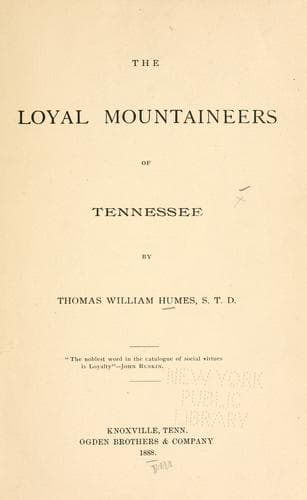
The loyal mountaineers of TennesseeHumes, Thomas William
Philosophy
The loyal mountaineers of Tennessee
Humes, Thomas William
Tennessee, East -- History -- Civil War, 1861-1865
But God is good, and His mercy is over all His works. He had already
put it into the heart of one of His servants to begin an enterprise
that would by His blessing bring help from a distance to the needy
people, more than a few of whom were ready to perish.
At that date war had wrought its ravages for more than three and
a-half years. For a large part of that period, in some regions of
the land, it had stayed the hand of the husbandman from industrious
toil and prevented the fruits of the earth. In many instances the
farmers’ barns were no longer, as formerly, filled with plenty, for
the words of Joel, so ominously read in churches on the Sunday after
the Baltimore fight in April 1861, had proved truly predictive, and
plough-shares had been turned into swords. Multitudes of hearts
everywhere from Maine to the Gulf, and from the Atlantic to the
far West, were now yearning for peace. Had not enough blood been
shed, enough human life sacrificed upon the altar of Mars? Might
not Americans cease now from destroying each other and brethren be
reconciled? Perhaps the night of desolation and sorrow was well-nigh
spent and the day of peace about to dawn! And so it was, but men did
not know it.
Soon kindly hands came in and healed where they could the wounds
war had inflicted. They fed the hungry and clothed the naked, until
by their industry they could feed and clothe themselves. It was a
Christ-like work in which any man might be thankful to be engaged.
CHAPTER XVIII.
DEPLORABLE CONDITION OF EAST TENNESSEE--WATAUGA SCENERY--LANDON
C. HAYNES AT A DINNER PARTY--NATHANIEL G. TAYLOR--HIS WRONGS--HIS
FEARS FOR THE PEOPLE--HIS MISSION TO THE NORTH AND WORK AT
PHILADELPHIA--EDWARD EVERETT’S SPEECH AT FANEUIL HALL.
“Alas, poor country;
Almost afraid to know thyself! It cannot
Be call’d our mother, but our grave; where nothing
But who knows nothing, is once seen to smile.”
MACBETH.
An intelligent observer of the condition of East Tennessee in the
spring of 1863, did not need any supernatural gift of prescience to
enable him to see that a dangerous scarcity of food would befall
its people at no very distant day. This evil especially impended
over counties where love for the Union was relatively strongest,
and from which means of sustenance for Confederate troops had been
more largely drawn. Twelve months had elapsed since Gen. E. Kirby
Smith, in chief command at Knoxville, had the sagacity to foresee the
ills that threatened the whole region because of the withdrawal of
nearly all its able-bodied men from agricultural pursuits, and had
thought it advisable to proclaim his promise that he would suspend
the operation of the conscript law until men should cultivate their
fields another season and raise crops of farm products.
Public-domain text, read in full here on John Shaqi.
Reviews
Reviews
No reviews yet
Be the first to share your thoughts on this work.
Elsewhere in the archive
Join the Discussion
Join the discussion
Sign in to leave a comment or review.
Sign InorCreate an account