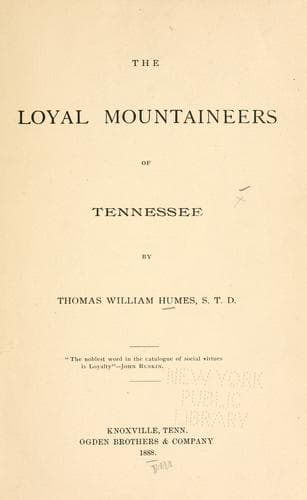
The loyal mountaineers of TennesseeHumes, Thomas William
Philosophy
The loyal mountaineers of Tennessee
Humes, Thomas William
Tennessee, East -- History -- Civil War, 1861-1865
Hon. Edward Everett stepped forward upon the platform and spoke. He
requested the respectful attention of the assembly to Mr. Taylor
on his own account, and also that they should “hear him for his
cause”--the cause, not simply of the Union, but of faithful Union
men who from the beginning of hostilities “had stood at the post of
danger; on whom the storm of war first broke, and on whom from that
day to this, it has beat with its wildest fury.” “At this distance
from the scene of war,” he said, “we hear only the far-off roar
of the tempest; but all its waves and billows have gone over the
devoted region for which our honored guest comes to plead.”
Mr. Everett then gave the true and beautiful description of East
Tennessee, which has been repeated in the Introduction to these
chapters. He said of that region:
“Overrun it may be by the armed forces of the rebellion, but all
its sympathies and attachments are with the loyal States. While the
aristocracy of the southeastern counties of Maryland, were shouting
‘My Maryland,’ the farmers in the western counties in Cumberland
Valley shouted back, ‘No, it’s our Maryland.’ Western Virginia, a
portion of the same grand chain of mountain and valley, is as loyal
as Massachusetts. Then comes Western North Carolina, and still
more, Eastern Tennessee, the home of our honored guest, and of as
true-hearted, loyal, Union-loving a population as there is on the
continent. As far down as Northern Alabama, the mountain district is
filled with Union sentiment. It was with the greatest difficulty it
was engineered into secession.”
In continuation the eloquent orator spoke of the large majority at
the polls in East Tennessee, February, 1861, against a convention
for the purpose of seceding and of the subsequent “outrages and
cruelties, of which the Union-loving inhabitants were made the
victims.” He told how, that “thrown upon their own resources, they
naturally sought to save themselves from being overrun by destroying
the bridges on the chief lines of communication,” and that in
consequence, the great majority of the people of the region were
subjected by the Richmond Government to great severities. In that
connection he read and sharply censured the letter of Mr. Benjamin,
Secretary (C. S.) of War, heretofore repeated.
In concluding, he said to his fellow-citizens that their brethren
of East Tennessee, fighting battles and suffering persecution,
represented a common cause, and he feared the promptest relief
extended would be too late to save some from starvation. “This,” he
added, “must not be. If the Union means anything, it means not merely
political connection and commercial intercourse, but to bear each
other’s burdens and to share each other’s sacrifices; it means active
sympathy and efficient aid.”
[Illustration: REV. N. G. TAYLOR.]
Public-domain text, read in full here on John Shaqi.
Reviews
Reviews
No reviews yet
Be the first to share your thoughts on this work.
Elsewhere in the archive
Join the Discussion
Join the discussion
Sign in to leave a comment or review.
Sign InorCreate an account