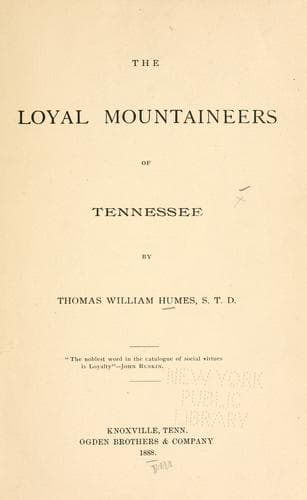
The loyal mountaineers of TennesseeHumes, Thomas William
Philosophy
The loyal mountaineers of Tennessee
Humes, Thomas William
Tennessee, East -- History -- Civil War, 1861-1865
Mr. Taylor followed with a fervent and impressive address, in which
he briefly related the historical events in East Tennessee from the
beginning of 1861, told of the wrongs inflicted upon its people, of
the voluntary exile of its men and their enlistment in the United
States army, of the desolation their homes and fields had suffered
from the war, of the deep, wide and threatening destitution existing
among them, and he appealed on their behalf to the prosperous people
among whom he stood, to send them help. He spoke plainly, with strong
and earnest convictions of the truth, and with the burning passion
which a sense of the injustices he narrated had enkindled in his
soul. Inspired with a profound and lofty patriotism, by the presence
of distinguished persons and a thronged audience on a spot of lively
associations with liberty and the Republic, and by the importance
of his theme, his speech was with unwonted power. His hearers were
carried away by his eloquence as on a mighty wave of enthusiasm, and
all criticism of his style, wherein it was not in harmony with the
demands of a higher culture, was forgotten in their glowing sympathy
with his subject and the ardent love of country to which his words
quickened them.
When he had finished, resolutions expressive of hearty fellowship
with the Unionists of East Tennessee in their fidelity and
sufferings, and of a ready mind to minister to their needs, were
presented by Geo. B. Upton and unanimously adopted. Hon. Rob’t C.
Winthrop said a few words, and Judge Thomas Russell spoke ardently,
more at length. He referred to the statements of Mr. Taylor
concerning destitution among the people whose cause he pleaded, and
said:
“Let me add that this testimony is confirmed by one of the Generals
who marched to relieve Burnside. General Blair has just told me a
touching story of the devotion of the women who crowded to the line
of his forced march, to welcome the sight of our armies; to wave the
flags which in evil days they had hidden in the secret recesses of
their homes, even as they kept the love of the Union in their hearts;
to bring the last piece of bacon, the last handful of meal, to feed
the advancing soldiers of the Union cause. Often he forbade his men
to take the scanty gifts of the poor. As often, he heard the reply,
‘Take it; I have a husband, a son, at Knoxville; take it all for the
Union.’ These are the people for whom our aid is sought.”
A letter was also read from Gen. Frank Blair, reciting the same
facts, and expressing his hope that liberality would “be stimulated
by remembrance of the kindness and devotion of the loyal women of
Tennessee who succored our toil-worn soldiers on their march to the
relief of their beleaguered brothers, many of whom were sons of
Massachusetts.”
CHAPTER XIX.
Public-domain text, read in full here on John Shaqi.
Reviews
Reviews
No reviews yet
Be the first to share your thoughts on this work.
Elsewhere in the archive
Join the Discussion
Join the discussion
Sign in to leave a comment or review.
Sign InorCreate an account