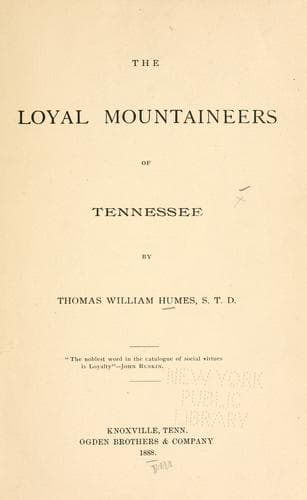
The loyal mountaineers of TennesseeHumes, Thomas William
Philosophy
The loyal mountaineers of Tennessee
Humes, Thomas William
Tennessee, East -- History -- Civil War, 1861-1865
In the spring Mr. Taylor visited Maine, and eleven thousand dollars
were given through Gov. Cony, and a relief association organized at
Portland. He also visited New York city upon invitation, but the
holding of a metropolitan fair at the place and time, prevented
any important results from his labors. His address there was well
received and a society formed which adopted means to promote the
object of his mission. A letter from Gen. S. P. Carter was read on
the occasion, dated at Knoxville a few weeks previous, in which he
said: “From 40,000 to 50,000 troops have been in East Tennessee
for more than four months; of that number, 10,000 to 15,000 were
cavalry. In a great measure both armies lived off the country. The
rebels drew all their supplies from it. Of course nearly the whole
of the forage subsistence of East Tennessee has been consumed. Many
families have been left without a bushel of corn or a pound of meat.
And it is certainly to the credit of the people, that although they
have been stripped of their substance by their own friends--by our
troops--there is no abatement of their love for the old Government.
Many rations have been issued daily from the Government stores; but
for this, more than a few would be without bread. Even those who have
supplies have only enough to last for a short time, and then, unless
assistance comes from abroad, many, I fear, will suffer terribly for
bread.” ... “From the destruction of fences, impressment of horses,
and absence of forage as well as laborers, I fear that only a small
part of our farms will be cultivated during the present year. Numbers
of the people are driven to seek homes north of the Ohio; many others
must follow, not willingly, but because there is no help for it.”
An address to the people of the State of New York, drafted by William
Cullen Bryant, Esq., was published by a large and influential
committee; but the aggregate of contributions to the New York city
relief fund was less than $20,000, of which one-fourth was from
Buffalo.
Mr. Taylor’s wife and children had of necessity left home, and with
them he dwelt at Haddonfield, N. J. As strangers, with narrow means
of support, their faith and patience were tried, and at one time
severely. They were delivered when in great need, by an interposition
that appeared to come from a Divine Providence.
The family of exiles, numbering thirteen, although not free from
painful recollections of recent life in Tennessee, were no longer
disturbed by alarms of war or shocked by atrocities of a hostile
soldiery, and were contented and happy in their new home. In the
afternoon of the day when Mr. Taylor returned from an absence of six
weeks in New England, his wife said to him:
“We are nearly out of provisions. You must go to market in the
morning. Besides, the rent is due next Monday and it must be met
promptly.”
Public-domain text, read in full here on John Shaqi.
Reviews
Reviews
No reviews yet
Be the first to share your thoughts on this work.
Elsewhere in the archive
Join the Discussion
Join the discussion
Sign in to leave a comment or review.
Sign InorCreate an account