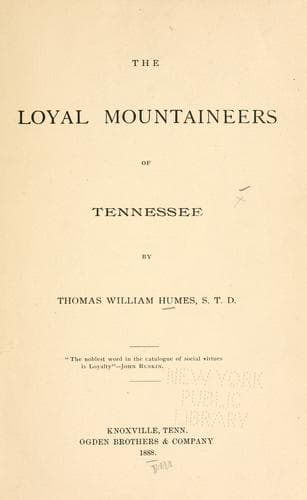
The loyal mountaineers of TennesseeHumes, Thomas William
Philosophy
The loyal mountaineers of Tennessee
Humes, Thomas William
Tennessee, East -- History -- Civil War, 1861-1865
“Well, of course I’ll go to market, and I’ll settle the house-rent;
but I suppose (drawing an almost empty purse from his pocket) you
will furnish the money, as I believe I am about broke.”
“Why, dear me,” she exclaimed, with lengthened face and fading color,
“is it possible you have come back home without money? You are surely
jesting.”
“Indeed, my dear wife, I am in dead earnest. All I have in the world
is this five dollar bill,”
For the first time in all their troubles, she lost faith and hope,
and was helpless. Overcome by emotion and unable to speak, she
dropped into a chair, sobbing. When the power of speech returned, she
bewailed their condition:
“Oh! oh! just think to what we have come. Here we are a thousand
miles from home. If we were there, enemies are ready to kill us.
Here we are among strangers, in a rented house--rent due--provisions
all gone--thirteen in family--and only that five dollar bill between
us and starvation.”
Confessedly, the case had a dark outlook, and to any person of
desponding mind it would appear desperate. Her paroxysms of grief
brought all the household together; they stood around in deep, silent
sympathy; but the head of the family soon rallied courage to speak in
a tone of cheerfulness, not very well sustained:
“My dear wife, I am astonished at your want of faith and extravagant
apprehensions. We are indeed among strangers, but they are our
friends. Would the Lord lead us through all the dangers we have
survived, only to let us starve here in a peaceful, prosperous land?
And that, when we are in His service--working for the poor and
destitute in unhappy East Tennessee? Away with your fears, and be
assured that the same God who has led us safely so far, will lead us
safely to the end.”
Her mind was calmed by these words, but they failed to remove
all its doubts and forebodings. Next morning, the husband went
to Philadelphia, armed with a bushel market basket, and after
payment for a round ticket by railroad, with his five dollar bill
distressingly reduced in size. Prices of provisions were high. He
had to buy inferior qualities to supply the needful quantity, and
to use thought and skill lest his little means prove unequal to the
occasion. At length he started homeward, with the basket cheaply but
plentifully filled, and in passing through Haddonfield was hailed by
the postmaster and given a letter for his wife. It was postmarked at
Boston. Who could have sent it? “Perhaps some of our rebel kin,” he
thought, “have been captured and taken to that city, and have written
to her.”
All day he had been praying inaudibly to the Lord for help, and he
believed it would come, but all his forecastings as to the whence,
how and when of its coming, had only been perplexing. He did not
dream it would be from strangers and a distance; yet his curiosity
was so keen to know who had written the letter that, contrary to his
habit, he broke the seal and read.
Public-domain text, read in full here on John Shaqi.
Reviews
Reviews
No reviews yet
Be the first to share your thoughts on this work.
Elsewhere in the archive
Join the Discussion
Join the discussion
Sign in to leave a comment or review.
Sign InorCreate an account