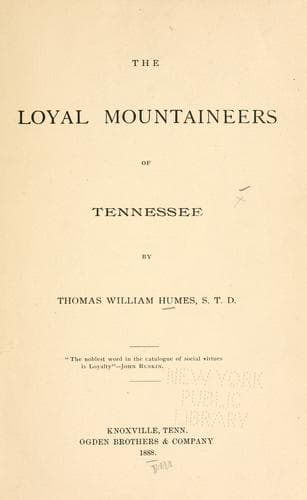
The loyal mountaineers of TennesseeHumes, Thomas William
Philosophy
The loyal mountaineers of Tennessee
Humes, Thomas William
Tennessee, East -- History -- Civil War, 1861-1865
The Pennsylvania Commissioners were well qualified for the duties
assigned to them, and which required they should make a tedious and
uncomfortable journey of 2,500 miles and of nearly three weeks’
time. They were heartily welcomed at Knoxville, and gave to its
Association a memorandum of their own Society’s judgment concerning
the distribution of supplies. They advised first, that the provisions
should be given away to those who were unable to buy, and secondly,
that to all other applicants they should be sold; the preference
to be given, among both classes, first to Union families who had
suffered on account of their loyalty; second, to families, who,
without having specially suffered, had adhered throughout to the
Federal Government; thirdly, to people who, whatever their past
conduct, had given their adhesion to the United States. Lastly, they
recommended that the old men, women and children of families which
then had representatives in the Confederate army should be permitted
to share in the bounty, no part of which, they thought, was intended
for secessionists of the fighting age. The plan thus proposed was
adopted by the Knoxville Association, and practically observed.
The Pennsylvania Commissioners informed themselves as far as possible
concerning the destitution said to prevail throughout the region.
Before they reached Knoxville, refugees had been arriving there
daily in growing numbers and some of them slept of necessity in the
open air. Gen. Carter, U. S. Provost Marshal, and Wm. G. Brownlow,
U. S. Treasury Agent, provided shelter for the needy. Rations were
also issued to them for a time and until the necessities of the army
prevented.[59] The destitution was found to be all that it had been
represented to persons at a distance.
Public-domain text, read in full here on John Shaqi.
Reviews
Reviews
No reviews yet
Be the first to share your thoughts on this work.
Elsewhere in the archive
Join the Discussion
Join the discussion
Sign in to leave a comment or review.
Sign InorCreate an account