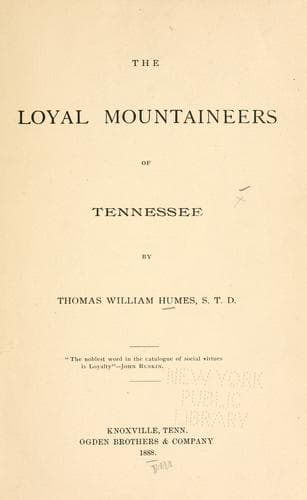
The loyal mountaineers of TennesseeHumes, Thomas William
Philosophy
The loyal mountaineers of Tennessee
Humes, Thomas William
Tennessee, East -- History -- Civil War, 1861-1865
Thrifty and well-to-do people were not exempt from it. One instance
came directly to the knowledge of the Commissioners. A member of the
Society of Friends from Blount County, sought for help from the U.
S. Quartermaster at Knoxville, saying that he and all his people had
nothing to eat. Before the peace of the country had been broken, they
lived in plenty. At various places the visitors met with refugees
on their way to the North in search of bread, not only from East
Tennessee, but from Western North Carolina, Northern Georgia and
Northern Alabama. Their losses had been entire, and having no means
to buy food and shelter by the way, they kept on fleeing, for behind
was threatening starvation. In their poorly clad and dispirited
condition, sickness among them, especially of women and children, was
inevitable. Pitiful cases of afflicted families came to the knowledge
of the Commissioners, such as that of a mother and four children, all
prostrated at the same time by disease. These unhappy emigrants were
to be counted by thousands, not always impelled only by hunger and
losses of property. Fear of being coerced to do military service for
the Confederacy was in some instances an additional motive. At one
town, a Western North Carolinian, nearly three-score years old, lay
dangerously ill. His distressed wife, standing at his bed-side, said:
“We came away because the ‘Rebs’ took away every thing from us and
were about to force my husband and my son, 17 years old, into their
army.”
At a point between Bridgeport and Chattanooga, the Commissioners,
detained by a railroad accident, approached a group of passengers,
decently but poorly dressed, huddling around a fire. They were
three families, thirteen persons in all, on their way to Vincennes,
Indiana, where they had friends. One old man, dressed in home-spun
and wearing a straw hat, said simply, “All gone!”.[60] He lived
eleven miles east of Knoxville, and when Burnside arrived, he
volunteered and was in camp five weeks, but he was then refused on
account of his age--being over sixty-six years old.
The evidences of a superior loyalty to the United States among East
Tennesseeans (and Western North Carolinians) were as conclusive to
the visitors from Philadelphia, as were those of great destitution.
A farmer who had emigrated and was returning home, told them that if
secession had succeeded, he would have left all and remained at the
North. He said, “I would rather protect the Government than protect
my property. If I had one bushel of corn, I would be glad to give
one-half of it to the Union men. We could do a heap of good, if we
could only stay there and raise truck for the army.” The mind he
expressed was that of the people generally, and justified the opinion
that “with the men of East Tennessee, devotion to the Union was not a
mere sentiment, but a passion.”
Public-domain text, read in full here on John Shaqi.
Reviews
Reviews
No reviews yet
Be the first to share your thoughts on this work.
Elsewhere in the archive
Join the Discussion
Join the discussion
Sign in to leave a comment or review.
Sign InorCreate an account