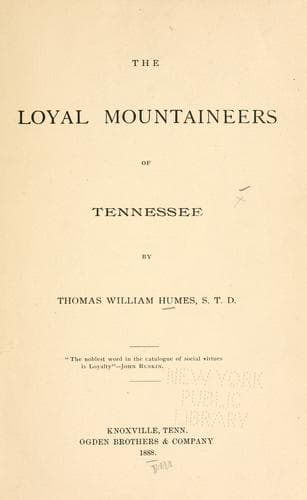
The loyal mountaineers of TennesseeHumes, Thomas William
Philosophy
The loyal mountaineers of Tennessee
Humes, Thomas William
Tennessee, East -- History -- Civil War, 1861-1865
“It is not saying too much to affirm that the history of our people
during the last four years, is one of the most remarkable chapters in
the history of the race. Enough is already known of it to excite the
admiration of all friends of the country. In Mr. Everett’s case, it
took a practical form--resulting in a fund of upwards of one hundred
thousand dollars in cash, expended with a sagacity and fidelity that,
aided by the benevolent of both sexes among our own citizens, will
make thousands of humble sufferers bless the memory of their distant
and unknown friend.”
The orator concluded with the words:
“As we follow his retreating form and begin to take the account of
our loss, I cannot help feeling that from the aggregate of learning,
the sum total of human knowledge, all that makes up the complex
idea of civilization and lends grace to the affairs of men, he, in
departing, has taken away a larger measure, than will in like manner
be withdrawn by any one he has left behind.”[61]
Twelve months after the work of relief began, the destitution was
largely diminished but still serious, especially in the most eastern
counties of the State, which military conditions had prevented from
being reached with supplies. When hostilities ceased, the people of
those counties being the most needy, received chief attention and
help from the Association, which distributed among them in 1865,
fifty thousand dollars in goods and provisions. Its ability to
do this, and at the same time assist the needy in other counties
was due to the faithful observance of the plan recommended by the
Pennsylvania Commissioners--by which, the supplies, excepting issues
without charge to the penniless, and sales at cost to soldiers’ wives
and widows who had means, were sold to citizens, able to pay, at an
advance. The results obtained, were as follows:
First, the aggregate receipts of the Association by gifts from a
distance, of one hundred and sixty-seven thousand dollars, were
increased to two hundred and fifty-two thousand dollars.
Second, the amount of cash paid for food and clothing, alone, was
more than that originally contributed. From the proceeds of sales
were also paid the cost of freight and insurance, the salaries,
wages and expenses of all officers, agents and employes; all other
necessary expenses; twelve thousand dollars for shoes and woolen
goods destroyed at Johnsonville; three thousand dollars for aid to
refugees at Nashville, and five hundred dollars sent to Portland,
Maine, which had given thousands to East Tennessee, and later had
suffered by a great fire.
Public-domain text, read in full here on John Shaqi.
Reviews
Reviews
No reviews yet
Be the first to share your thoughts on this work.
Elsewhere in the archive
Join the Discussion
Join the discussion
Sign in to leave a comment or review.
Sign InorCreate an account