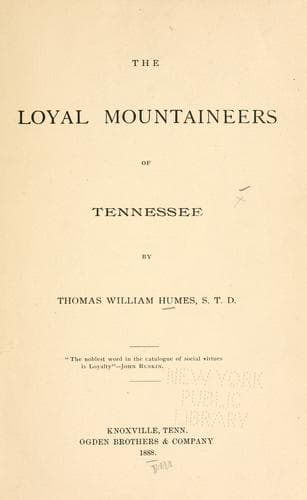
The loyal mountaineers of TennesseeHumes, Thomas William
Philosophy
The loyal mountaineers of Tennessee
Humes, Thomas William
Tennessee, East -- History -- Civil War, 1861-1865
NOTE A: Love of Religious Excitement.
“ B: Contrary Statements; Sevier and Tipton.
“ C: A Southerner’s Letter, in 1861.
“ D: Rev. Herman Bokum.
“ E: A New Yorker’s Letter, in 1861.
“ F: Col. David Cummings.
“ G: Delegates to Union Convention.
“ H: “ “ “ “
“ I: Employment of Bloodhounds.
“ J: Verse on the Execution of Haun and the Harmons.
“ K: Edward J. Sanford’s Narrative.
“ L: Heroism of East Tennessee Women.
“ M: Gen. Samuel P. Carter’s Raid.
“ N: Lieut. S. T. Harris, at Columbia, S. C., &c.
“ O: Report of Col. Wm. P. Sanders’ raid.
“ P: Report of Col. R. C. Trigg, (C. S. A.)
“ R: Letter from Gen. Longstreet.
“ S: Concerning Knoxville refugees.
“ T: Capt. Poe’s Topography of Knoxville.
“ U: Gen. Sherman’s dinner with Gen. Burnside.
“ V: Col. E. P. Alexander, (C. S. A.) concerning the siege.
“ W: List of superior U. S. A. officers from East Tennessee.
“ X: Martyrdoms of non-combatant Unionists.
“ Y: Concerning gifts at Boston to East Tennessee relief.
“ Z: Receipts and expenditures for East Tennessee relief.
APPENDICES.
APPENDIX: NOTE A: Page 27.
The love of religious excitement, attributed by the ex-United States
Consul at Singapore, to the mountaineers of East Tennessee, is apt to
exist among a civilized, yet, uneducated people, who lead a simple,
natural life. Its indulgence was formerly much greater in the Western
States.
A religious excitement sprung up in East Tennessee in 1802, which
was attended with remarkable bodily manifestations, familiarly
called “the jerks.” The affection included among its subjects
equally the young and old, the strong and weak, the good and bad in
previous moral character, those who desired and those who hated it.
Involuntary, it had no premonitory symptoms, and left the patient
as he was before. The very atmosphere seemed to be laden with an
influence that brought the mind and body into relation and sympathy
that were abnormally close. If the preacher, after a smooth and
gentle course of expression suddenly changed his voice and language
to the awful and alarming, instantly some dozen or twenty persons or
more would simultaneously be jerked forward where they were sitting,
with a suppressed noise, once or twice, like the barking of a dog.
And so it would continue or abate, according to the tenor or strain
of the discourse.
Public-domain text, read in full here on John Shaqi.
Reviews
Reviews
No reviews yet
Be the first to share your thoughts on this work.
Elsewhere in the archive
Join the Discussion
Join the discussion
Sign in to leave a comment or review.
Sign InorCreate an account