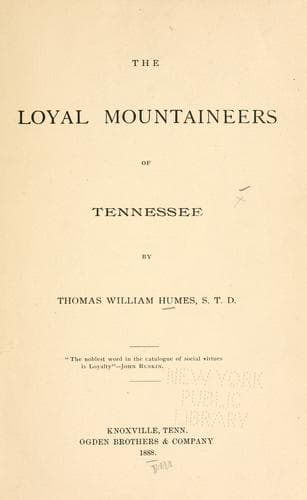
The loyal mountaineers of TennesseeHumes, Thomas William
Philosophy
The loyal mountaineers of Tennessee
Humes, Thomas William
Tennessee, East -- History -- Civil War, 1861-1865
A small portion of this command, who were out some distance from
the camp, with their horses, escaped and gave the first notice of
Sanders’s approach, at Knoxville, Kingston, Loudon and other places.
From that point he marched toward Kingston. When within eight miles
of it, he learned positively that Scott’s brigade and one battery
were at that place, guarding the ford of Clinch River. For this
reason, leaving Kingston to his right, he crossed the river eight
miles above, at Waller’s Ford on the direct road to Loudon. At
daylight, on the 19th (June), he was within three miles of Loudon,
and about the same distance from Lenoir’s. He there learned that a
force of three regiments was at the Loudon bridge, with eight pieces
of artillery, and that they had been for two weeks strengthening
the works at that place, digging rifle pits, ditches, &c. A courier
was captured from the commanding officer at Loudon, with dispatches
ordering the forces from Kingston to follow in Sanders’s rear, and
stating that the troops from Lenoir’s had been ordered to join them.
Sanders determined to avoid Loudon and started immediately for
Lenoir’s station, which place he reached about 8 A. M., arriving
there about thirty minutes after the departure of the rebel troops.
At that station he captured a detachment of artillerymen, with three
6 pounder iron guns, eight officers and fifty-seven enlisted men,
burned the depot, a large brick building, containing five pieces
of artillery, with harness and saddles, two thousand five hundred
stand of small arms, a very large amount of artillery and musket
ammunition, and artillery and cavalry equipments. The depot was
entirely occupied with military stores, and one car filled with
saddles and artillery harness. He also captured some seventy-five
Confederate States mules and horses. There was a large cotton
factory with a large amount of cotton at the place, and he ordered
that it should not be burned, as it furnished the Union citizens of
the country with their only material for making cloth, but it was
burned by mistake or accidentally. He had the telegraph wire and
railroad destroyed from there on to Knoxville, at points about one
mile apart. He met the enemy’s pickets at Knoxville about 7 P. M.
on the 19th (June,) and drove them to within a mile of the city.
Leaving a portion of the 1st Kentucky Cavalry on the southwest side
of the town, he moved the rest of his command as soon as it was dark
by another road entirely around to the other side, driving in the
pickets at several places, and cut the railroad, so that no troops
could be sent to the bridges above. At daylight he moved up to the
city on the Tazewell road and found the enemy well posted on the
heights and in the adjacent buildings, with eight or nine pieces of
artillery. The streets were barricaded with cotton bales, and the
batteries protected by the same material. Their force was estimated
at 3,000, including citizens who were impressed into service. After
Public-domain text, read in full here on John Shaqi.
Reviews
Reviews
No reviews yet
Be the first to share your thoughts on this work.
Elsewhere in the archive
Join the Discussion
Join the discussion
Sign in to leave a comment or review.
Sign InorCreate an account