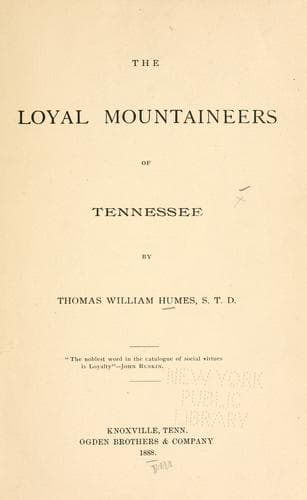
The loyal mountaineers of TennesseeHumes, Thomas William
Philosophy
The loyal mountaineers of Tennessee
Humes, Thomas William
Tennessee, East -- History -- Civil War, 1861-1865
Captain Harris relates that he was hurried off with other prisoners
under guard from Columbia, that they might not be delivered by Gen.
Sherman’s army, and that, having learned while in prison at Knoxville
the trick of slipping off his chains at pleasure, he released himself
of those with which he had been bound in Columbia and left them in
a swamp. He was paroled at Charlotte, N. C., and in exchange for
Captain Ellison of the C. S. Army, a prisoner at Nashville held
as hostage for him by order of President Lincoln, he was finally
transferred from Wilmington, to the United States authorities. On
his return to Knoxville, where he had forgiven all his enemies when
expecting soon to be executed, he did not fully illustrate the saying
of the poet, that young men “soon forget affronts;” but meeting with
one who had sought his life when a helpless prisoner, he remembered
the wrong, and in a brief interview redressed it to his enemy’s
discontent.
APPENDIX: NOTE O: Page 207.
[From official reports concerning the Sanders raid in East Tennessee,
June 14-24, 1863.]
Colonel William P. Sanders, in obedience to special instructions
from the General Commanding the Department, left Mount Vernon,
Kentucky, June 14, 1863, with a force of 1,500 mounted men, composed
of detachments of different regiments, as follows: Seven hundred of
the 1st East Tennessee mounted Infantry, under Colonel R. K. Byrd;
200 of the 44th Ohio mounted infantry, under Major Moore; 200 of the
112th Illinois mounted infantry, under Major Dow; 150 of the 7th Ohio
Cavalry Volunteers, under Captain Rankin; 150 of the Second Ohio
Cavalry Volunteers, under Captain Welch; 100 of the First Kentucky
cavalry Volunteers, under Captain (G. W.) Drye, and a section of
Captain Konkle’s battery. First Regiment Ohio Artillery Volunteers,
under Lieutenant Lloyd,--for the East Tennessee and Virginia
Railroad. From Mount Vernon to Williamsburg, on the Cumberland river,
a distance of sixty miles, a train of wagons containing forage and
subsistence stores, accompanied the expedition. From this point, he
followed a route known as the Marsh Creek road to near Huntsville,
Tennessee, leaving that place a few miles to his left. He reached
the vicinity of Montgomery, Tennessee, on the evening of the 17th of
June, and learning that a small party of rebels were stationed at
Wartburg, one mile from Montgomery, he sent 400 men from the 1st East
Tennessee to surprise and capture them, following one hour afterward
himself with the remainder of the command. The surprise was complete.
They captured 102 enlisted men and two officers (one of them an aide
to General Pegram,) together with a large number of horses, sixty
boxes artillery ammunition, several thousand pounds of bacon, salt,
flour, and meal, some corn, 500 spades, 100 picks, besides a large
quantity of other public stores, and six wagons with mule teams. The
prisoners were paroled, and the property destroyed.
Public-domain text, read in full here on John Shaqi.
Reviews
Reviews
No reviews yet
Be the first to share your thoughts on this work.
Elsewhere in the archive
Join the Discussion
Join the discussion
Sign in to leave a comment or review.
Sign InorCreate an account