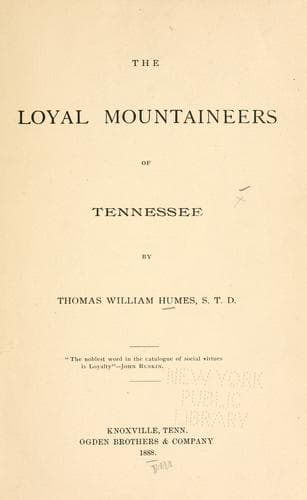
The loyal mountaineers of TennesseeHumes, Thomas William
Philosophy
The loyal mountaineers of Tennessee
Humes, Thomas William
Tennessee, East -- History -- Civil War, 1861-1865
He determined to leave the railroad here and endeavor to cross the
mountains at Rogers’ Gap, as he knew every exertion was being made
on the part of the enemy to capture his command. Fording the Holston,
at Hayworth’s Bend, he started for the Powder Spring Gap of Clinch
Mountain. There a large force was found directly in his front, and
another strong force overtook and commenced skirmishing with his rear
guard. By taking country roads he got into the Gap without trouble or
loss, and had all this force in his rear. On arriving within a mile
and a-half of Rogers’ Gap, he found that it was blockaded by fallen
timber, and strongly guarded by artillery and infantry, and that all
the gaps practicable were obstructed and guarded in a similar manner.
He then determined to abandon his artillery and move by a wood path
to Smith’s Gap, three miles from Rogers’ Gap. The guns, carriages,
harness and ammunition were completely destroyed, and left. He had
now a large force, both in front and rear, and could only avoid
capture by getting into the mountains, and thus place all his foes
in the rear, which he succeeded in doing, after driving a regiment
of cavalry from Smith’s Gap. The road through this pass was only a
bridle path, and very rough. He did not get up the mountain until
after night. About 170 of his men and officers got on the wrong road,
and did not rejoin the command until it reached Kentucky.
Owing to the continual march, many horses gave out and were left, and
although several hundred were captured on the march, they were not
enough to supply the men. He reached Boston, Ky., on the 24th, with a
loss of two killed, four wounded and thirteen missing. The number of
prisoners paroled by him was 461.
After acknowledging his indebtedness for the success of the
expedition to several officers of his command, Col. Sanders did
so chiefly to Sergeant Reynolds, First East Tennessee volunteers,
and his guides. He said: “Reynolds’ knowledge of the country was
thorough, reliable and invaluable.” “All the officers and men
deserved great credit and praise for the cheerfulness with which
they submitted to great hardships and fatigue, and their energy and
readiness at all times either to fight or march.”
APPENDIX: NOTE P: Page 207.
[Confederate account of the fight at Knoxville, in the Sanders Raid,
condensed from the Report of Lieut. Col. Milton A. Haynes, C. S.
Artillery, to Maj. Von Sheliha, Chief of Gen. Buckner’s staff.]
DEPARTMENT OF EAST TENNESSEE,
KNOXVILLE, JUNE 21, 1863.
Public-domain text, read in full here on John Shaqi.
Reviews
Reviews
No reviews yet
Be the first to share your thoughts on this work.
Elsewhere in the archive
Join the Discussion
Join the discussion
Sign in to leave a comment or review.
Sign InorCreate an account