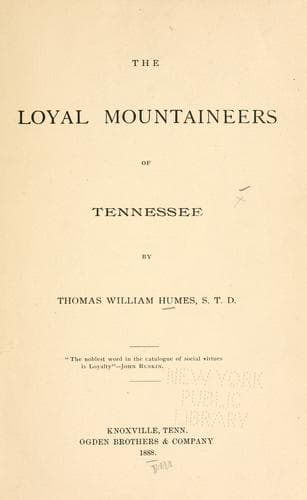
The loyal mountaineers of TennesseeHumes, Thomas William
Philosophy
The loyal mountaineers of Tennessee
Humes, Thomas William
Tennessee, East -- History -- Civil War, 1861-1865
One of the party of refugees from Knoxville, as Longstreet approached
it, relates: “The attention of wayside inhabitants, on the occasion
of this escapade was the sharper, because the news of Longstreet’s
advance had already spread through the country; and many were the
questions with which the excited and curious population plied
the fleeing party; such as “What is the matter,” etc., etc. The
discomfort of the travellers was especially relieved by the tongue
of an elderly woman whom they encountered. In order to relish the
amusement her sallies afforded them it should be remembered that
“Parson Brownlow” as he was often called, not only had great popular
notoriety, but was as highly esteemed by one party to the strife as
he was intensely hated by the other. By the rebels he was thought to
be,
“The very head and front of their offending.”
By the Union people he was everywhere known as their fearless and
indomitable champion; and the idea of his giving way before the
coming of their foes, could find place in their minds only along side
of a desperate emergency.
As we plunged along with the north star for our main guide, we
were continually hailed to know what was the trouble, and what was
the state of things at Knoxville? It is specially remembered that
just after entering Anderson County, we were saluted by one of the
numerous families peculiar to that region, headed by the matron,
torch in hand:
‘What in the name of goodness does all this mean? and where are you
men going? Is Burnside retreating? or who are you any how?’
It was mildly answered to her by one of the more polite-mannered
gentlemen of the party, that Gen Burnside, so far from being able to
retreat, was in all probability a prisoner with his whole army.
‘And are you running,’ exclaimed she, ‘without firing a gun?’ ‘Oh
no!’ said an elderly gentleman; ‘we are simply retiring in good
order, to save the country.’
‘Yes!’ said she, as she flamed her torch with a sort of patriotic
fierceness; ‘I expect the next thing I’ll hear will be that Old Bill
Brownlow is running too!’
At this juncture, the reverend gentleman so irreverently referred to,
in a subdued tone of voice, remarked:
‘Gentlemen, this is no place to make a stand; I think I’d rather
encounter Longstreet’s army, or Vaughn’s cavalry, than that
woman.’”[65]
Capt. A. J. Ricks, the military escort of the party says: “One man
of the group, from the beginning of the hazardous ride, impressed me
with the coolness, judgment and courage, with which he confronted
dangers, and advised as to the best means of avoiding them; and
it was soon apparent that the distinguished band looked to him as
leader and adviser. And when, at an hour that all agreed my orders
required me to leave them to their own chances and I parted from them
with many misgivings as to their safety, I noticed that they all
instinctively turned to John Baxter, as pilot and commander.”
Public-domain text, read in full here on John Shaqi.
Reviews
Reviews
No reviews yet
Be the first to share your thoughts on this work.
Elsewhere in the archive
Join the Discussion
Join the discussion
Sign in to leave a comment or review.
Sign InorCreate an account