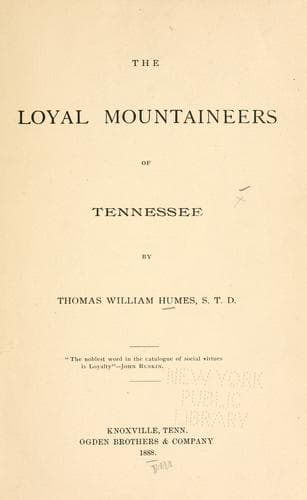
The loyal mountaineers of TennesseeHumes, Thomas William
Philosophy
The loyal mountaineers of Tennessee
Humes, Thomas William
Tennessee, East -- History -- Civil War, 1861-1865
They did so with good reason, for he had quick and accurate judgment
and a powerful will. Mr. Ricks, now of Massilon, Ohio, in his address
at a meeting of the bar of northern Ohio, held at Cleveland, Ohio,
April 6, 1886, concerning the recent death of the Hon. John Baxter,
of the U. S. Circuit Court, related some interesting incidents in the
Judge’s personal history during the civil war.
“No one of all the famous Union men of that conspicuously loyal
section, (East Tennessee,) was more fearless, consistent or
aggressive in the struggle against secession than our departed
friend. He was a leader in the historic Union Convention of 1861,
which held its session, planning open opposition to the Confederacy,
while rebel regiments by the train load, destined for Virginia, were
passing by within hailing distance. Johnson, Maynard, Brownlow,
Nelson and Baxter were the leading spirits in its deliberations.
“Although the disposition of many members of that convention to make
organized armed resistance at once, and to put Baxter in command of
the forces was not approved by his knowledge of the environment, he
was recommended from Greeneville to President Lincoln for a Brigadier
General’s commission in the army. This honor was tendered, but for
satisfactory reasons was declined.
“In 1862, while on professional business at Memphis, he was arrested
by the Confederate military authorities and confined to prison
sixteen days, refusing to take the oath of allegiance to the Southern
Confederacy, but finally, he was unconditionally released.
“In 1861, he defended three Union men[66] before a Confederate
Military Commission. They were charged with having burned railroad
bridges in aid of the Union cause. He argued against the jurisdiction
of the tribunal, contending that so long as the civil courts were
open and the due course of legal proceedings was uninterrupted, the
citizens arraigned were entitled to a trial by jury, after indictment
by a grand jury, a doctrine long afterwards affirmed by the Supreme
Court, in the Milligan case.
“In 1862, a gallant band of Ohio soldiers, known as the Mitchell
raiders, who, in a lawful military expedition, had seized some
engines and cars and run them towards the Federal lines, were
captured and tried before a court-martial as spies. Baxter
volunteered to defend them and made a fearless argument for them
before the court-martial at Knoxville, urging that they were not
spies engaged in a sneaking expedition, but that taking the risks
of war, they had made an open venture as soldiers under legitimate
military orders, and were entitled to be treated as prisoners of
war, subject to exchange, &c. But the spirit of animosity was then
so great, that the argument of the Union lawyer was of no avail, and
seven of the brave men were shot as spies, while five others escaped
during the excitement of a retreat. One of them is now a prominent
Methodist clergyman of this State.
Public-domain text, read in full here on John Shaqi.
Reviews
Reviews
No reviews yet
Be the first to share your thoughts on this work.
Elsewhere in the archive
Join the Discussion
Join the discussion
Sign in to leave a comment or review.
Sign InorCreate an account