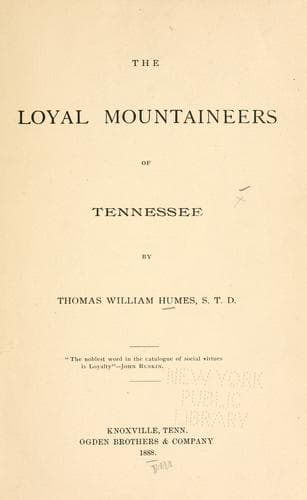
The loyal mountaineers of TennesseeHumes, Thomas William
Philosophy
The loyal mountaineers of Tennessee
Humes, Thomas William
Tennessee, East -- History -- Civil War, 1861-1865
Hon. C. W. Hall, of Rogersville, Tenn., in 1861-2, in “Threescore
Years and Ten, by a Lawyer” (Cincinnati, 1884), tells of such
atrocities. He says: “Guerilla bands claiming to belong to the Rebel
army, were engaged generally in the plunder of Union families. One
of these bands was commanded by one William Owens. His company was
a band of cut-throats, marauding around, seeking to shed blood.
They found a lad of some sixteen years, whose name was Lizemore.
His father was a Union man and quite aged. This gang of desperadoes
arrested the old man, took the boy into the woods and deliberately
murdered him. Whether the Confederate Commander in East Tennessee
commissioned Owens to plunder and kill in order to subdue the loyal
sentiment of that section, as Reynolds and others were trying to do
in other counties is not stated. One fact is known, viz.: that Owens
was recognized by the Rebel military as a Captain.” After detailing
the cruel treatment to which Union people were subjected, Judge Hall
adds: “These outrages were not confined to the more populous portions
of the counties, but were often perpetrated in the hills and hollows,
and usually upon men reputable at home, but bold enough to confess
their loyalty. Indeed it was a rare thing to find a man who had a bad
character before the war, advocating the Union cause.”
APPENDIX: NOTE Y: Page 317.
The list of contributors to the Boston Fund for the relief of
East Tennessee, is interesting. Some sent their proper names with
their gifts. Mr. George F. Bartlett, of New Bedford, wrote to Mr.
Everett: “In response to Col. Taylor’s touching appeal in behalf of
our suffering loyal brethren in East Tennessee, I cheerfully part
with the only thing saved from the whaleship ‘Lafayette,’ burned by
the pirate ‘Alabama,’ April 15, 1863, off Fernando de Noronha, and
enclose the same to you herewith, viz: (6) six English sovereigns,
worth about forty-three dollars. Captain Lewis was fortunately on
shore with this gold to purchase stores, when Capt. Semmes steamed
around the island and burned his ship. I will regard it as a
_forced_ contribution from Capt. Semmes, in the name of the immortal
Lafayette, who loved our country and its Father, and I am most happy
in being able to make so worthy a bestowal of it.”
Hon. J. L. Motley, Jr., U. S. Minister at Vienna, wrote: “I enclose a
check for $200, and I wish it was in my power to send a much larger
sum. When, in after days, the history of this unexampled insurrection
against Liberty comes to be written, there will be few episodes more
moving or more instructive than the record of those Tennesseeans who
have so long sustained the Republic and its principles, amid such
trial and at such sacrifices. Certainly it is no _charity_ on our
part to assist them, but a sacred duty, which I am sure that all will
fulfill in proportion to their means.”
Public-domain text, read in full here on John Shaqi.
Reviews
Reviews
No reviews yet
Be the first to share your thoughts on this work.
Elsewhere in the archive
Join the Discussion
Join the discussion
Sign in to leave a comment or review.
Sign InorCreate an account