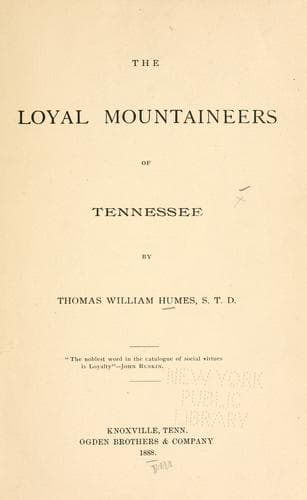
The loyal mountaineers of TennesseeHumes, Thomas William
Philosophy
The loyal mountaineers of Tennessee
Humes, Thomas William
Tennessee, East -- History -- Civil War, 1861-1865
Master John W. Pierce, Jr., twelve years old, wrote from S. W.
Harbor, Tremont, Maine: “Dear Sir: Enclosed please find twenty-five
dollars, which I have collected for the suffering East Tennesseeans.
I had read and heard so much of these loyal people that I wished very
much to do something for them. I said to my mother, I will give them
my dollar, _all my money_. She said that will do very little good
alone, but I might go round and ask my young friends to give for
this noble cause. I was pleased to do so, and have collected this
sum. I found both old and young ready to give me something; very few
refused. In one family I got almost five dollars. I know this is
a small sum compared with the thousands you are receiving, but if
some little boy in each town in this State would go round among his
friends, the sums thus collected would make thousands of dollars, and
oh! how much suffering would be relieved.”
Some, in transmitting their gifts, substituted for their proper
names, such inscriptions, as “A little boy, six years old, his
own money,”--“A poor ex-teacher,”--“A school girl’s monthly
allowance,”--“A law student at Cambridge, being one-half of all he
has,”--“C. and J., two poor young men,”--“Three little sisters,”--“A
Vermont soldier on the Potomac,”--“One day’s pay of a navy yard
employe,”--“A lady, aged 83,”--“Acts, 11th ch., 26 and 27th
verses,”--“The earnings of a little boy,”--“A poor old duster.” The
citizens of historic Lexington sent $280, and eight little girls,
$80, the proceeds of a fair they held at Plymouth. The Pastor of
the Second Church in Dorchester, in remitting its contribution “for
the patriots of East Tennessee,” said: “We observe a fourth Sabbath
evening of each month as a time for prayer for our country, and last
evening thought it fitting to _act_ as well as _pray_.” The Pastor of
the Congregational Church at Taunton, delivered a special sermon in
the same behalf, and the responsive offerings of his people amounted
to $870. From the Unitarian Society at Watertown, founded in 1630,
its Pastor sent a handsome contribution “for brothers who suffer
for their dear country’s cause and glory.” The 44th Regiment of
Massachusetts volunteers had been given $5,000 by fellow-citizens.
One-fifth of the sum was transferred through the Colonel to the
fund “for the relief of the suffering loyalists of East Tennessee.”
“Anonymous” enclosed $500 in a note, saying: “I have stood in the
fight many a day by the side of those East Tennesseeans, but I see
that there are yet other ways of doing one’s duty towards them, so I
add my contribution to their aid.” Another “Anonymous” wrote: “Fifty
dollars from one, who in days of yore was a short sojourner about
Knoxville, and whose then estimate of East Tennesseeans has been
borne out and tested.” “A Young Ensign” left his gift, as he “went
forth to serve his country.”
Public-domain text, read in full here on John Shaqi.
Reviews
Reviews
No reviews yet
Be the first to share your thoughts on this work.
Elsewhere in the archive
Join the Discussion
Join the discussion
Sign in to leave a comment or review.
Sign InorCreate an account