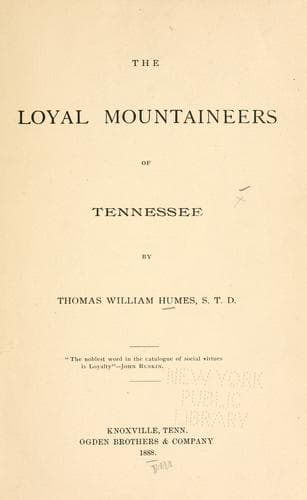
The loyal mountaineers of TennesseeHumes, Thomas William
Philosophy
The loyal mountaineers of Tennessee
Humes, Thomas William
Tennessee, East -- History -- Civil War, 1861-1865
Soon the end of the battle is at hand, and all is a more violent
storm of strife and tumult, freighted with wounds and death. Ferguson
is in the midst of it, calmly courageous but restlessly active. He
is here and there all over the field--wounded in his right hand,
but heedless of personal danger--giving courage to others as he
goes, and bearing the silver whistle, whose sharp sound quickens his
men’s pulses to the fray. He orders the cavalry into action and his
regulars to charge, but at last, in vain. The Americans press him
on all sides into ever narrowing limits. A white flag goes up from
the Tories and he pulls it down. Another is raised at a distance,
and quickly he is there to level it with the dust. A surrender is
suggested to him by friends, repeatedly, but he will not listen to
it. He _will not_ give up his sword to men whom, with a curse, he
calls “banditti”: but he will escape by cutting his way through the
hostile ranks with a sword in his left hand. Two officers join him in
the attempt. Dashing at a weaker point in the Whig lines, he strikes
with his sword until it is broken, and falls, pierced with bullets.
Instantly De Peyster surrenders. The battle is finished. It was about
an hour long.
In the confusion that followed, the Whigs ceased not at once from
firing. The British called for quarter, but kept their weapons. The
fearless Shelby galloped up to their lines and commanded, if they
wanted quarter, to lay down their arms. Perhaps animosity against
the Tories would not die in some Whigs as soon as white flags were
raised, for wars between neighbors are apt to be next in bitterness
to religious wars. Some allowance also is to be made for the
difficulty of self-restraint common to men in the heat of passion and
strife. Their destructive zeal is slow to abate. Col. Campbell had
to cry out to his men, “Don’t shoot!” “Cease firing!” and actively
to promote mercy; but when De Peyster profanely complained to him
of the unfairness, he declined with dignity, to reply, except by
ordering the prisoners into position. The victory was complete. Of
the soldiers composing Ferguson’s army, two-thirds were prisoners and
the other third were killed and wounded in nearly equal numbers. Of
the Americans, twenty-eight were killed and sixty-two wounded. Eight
days after the battle the conquerors began their march westward.
They had received information, which proved untrue, that Tarleton, a
bold, skillful and ruthless British officer, was advancing upon them.
On the contrary, Cornwallis and Tarleton were fleeing at the time
from Charlotte to South Carolina, in fear that the mountaineers by
thousands were about to assail them. The intention and hope of the
British commander to bring North Carolina, and then Virginia, into
like subjection with South Carolina and Georgia, were frustrated by
the defeat of Ferguson. It disheartened Tories who had openly taken
sides with the British, and deterred others from following their
example.
Public-domain text, read in full here on John Shaqi.
Reviews
Reviews
No reviews yet
Be the first to share your thoughts on this work.
Join the Discussion
Join the discussion
Sign in to leave a comment or review.
Sign InorCreate an account